Gorges de la Falaise: Martinique's Hidden River Walk
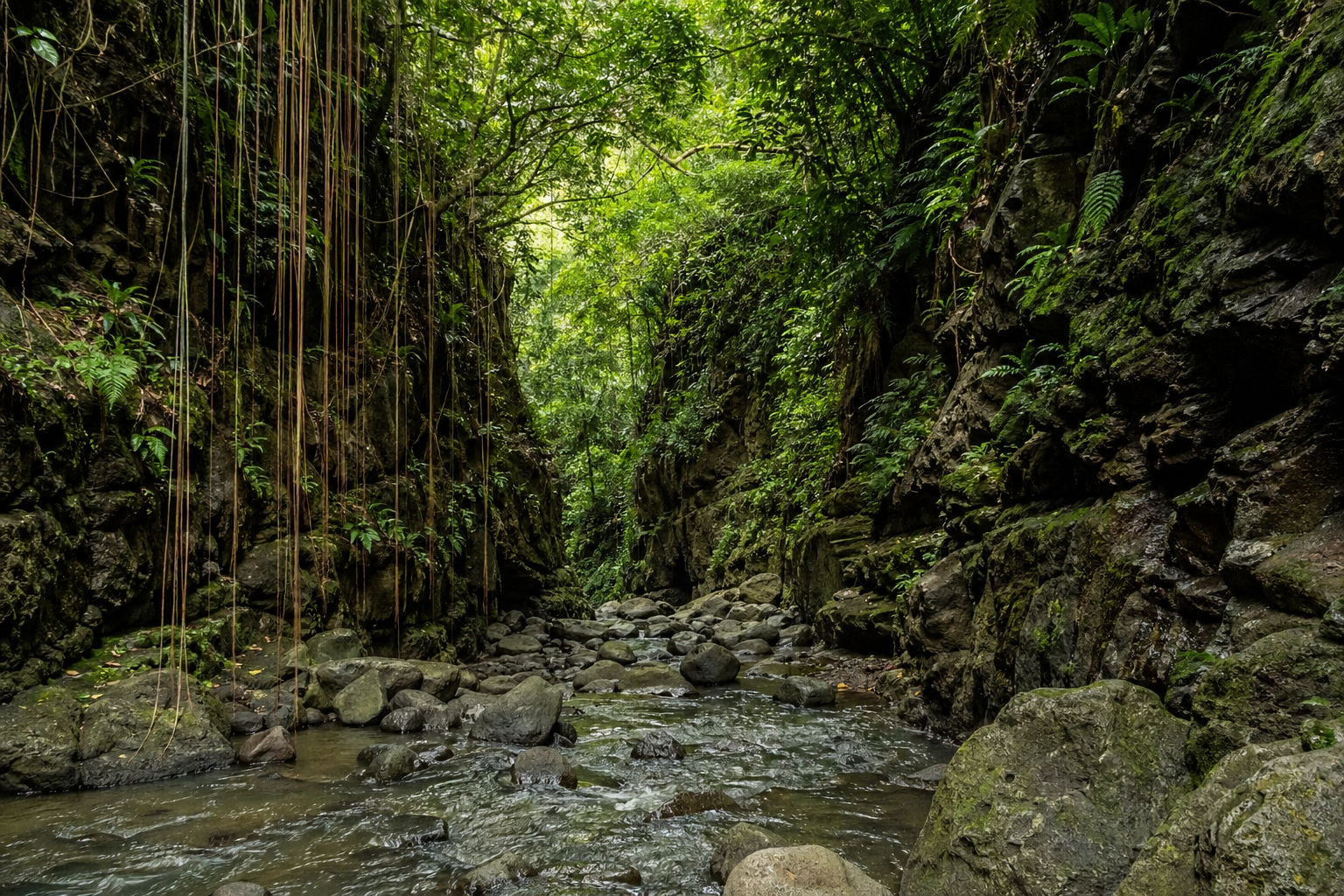
There is a canyon in northern Martinique where you walk through a river. Not alongside one — through it. You wade upstream along the Falaise River between two moss-covered cliffs that close in overhead as the water rises from your ankles to your knees to occasionally your armpits, past fern-draped walls and natural swimming pools carved by centuries of water working through volcanic rock, until the gorge ends at a waterfall dropping from height into a deep natural pool where you can stand directly under the cascade and let it hammer the heat out of you. The whole thing takes about an hour. It costs €10. It is one of the most consistently described trip highlights in Martinique by visitors who discover it — and almost no English-language travel guide gives it a page of its own.
That changes here.
Where It Is
The Gorges de la Falaise are located just outside Ajoupa-Bouillon, a small agricultural village sitting in the forested foothills at the northeastern base of Mount Pelée, approximately 40 kilometres north of Fort-de-France. The village name translates roughly as "broth shelter" — a reference to the hot springs and constantly running water that characterize the area — and it sits in one of the most lush and rain-soaked zones on an island that has no shortage of either.
The Falaise River itself flows directly off the slopes of Mount Pelée — the same volcano whose 1902 eruption killed 30,000 people and reshaped the northern landscape entirely. Over millennia, the river has carved a narrow gorge through volcanic rock that now forms the canyon walls you walk between. Those walls are covered in every variety of tropical hydrophilic plant that thrives in perpetually wet rock — mosses, ferns, small orchids, and dense vegetation that turns the gorge walls the kind of layered green that doesn't exist at sea level.
"The water temperature in the gorge is a consistent 22°C — warm enough to be comfortable, cool enough to be genuinely refreshing in the Martinique heat."
The Experience
The Gorges de la Falaise is not a conventional hike. It's a river walk — an aquatic trail — and the experience unfolds in a sequence that is genuinely surprising even for visitors who think they know what they've signed up for:
- The approach: From the car park near Démaré quarter, the guide leads you down a short path through rainforest — steep wooden stairs and earth steps descending to the river level, approximately 80 metres of altitude drop. This is the section that requires the most physical effort of the entire experience because you have to climb back up the same stairs at the end. If you have fragile knees or hips, this section is worth thinking about carefully.
- River entry: You step into the Falaise River at its base and begin walking upstream. The river bed is smooth volcanic rock carved into natural channels and pools — you're not scrambling over sharp boulders but moving through a water-carved landscape that has been smoothed by millennia of flow.
- The gorge narrows: As you progress upstream the canyon walls close in. Depending on rainfall in the preceding days, the water level varies significantly — in dry periods it stays thigh-deep in the main channels; after heavy rain it can reach chest height in the deeper pool sections. The guide adjusts the route based on conditions.
- Natural pools and ladders: The river drops in a series of natural steps, creating deep pools that require brief swims rather than wades. Metal ladders anchored into the rock allow you to climb between levels inside the water — a genuinely unusual piece of infrastructure that underlines the designed-for-visitors nature of the site while never feeling artificial.
- The waterfall: The gorge ends at the Falaise waterfall — multiple cascading streams dropping from considerable height into a large natural pool. This is where you swim. Reviewers consistently describe standing under the main cascade as one of the most physically exhilarating experiences on the island — the volume of water, the height, and the cool temperature combine into something that visitor after visitor describes as the moment they stopped trying to take photographs and just stood there. The falls are tall enough that looking up at them from the pool floor requires leaning your head back fully.
- The return: Same route back — downstream, through the pools, down the ladders, along the river, and back up the stairs. Total time from river entry to exit: 45 minutes to 1.5 hours depending on pace and water conditions.
The Guide
A guide is mandatory — you cannot enter the gorge independently. This is not a bureaucratic obstacle. The guide reads the water conditions, knows which sections to wade and which to swim, ensures nobody attempts anything beyond their ability, and provides the safety ropes attached to the gorge walls that allow you to cross deeper sections without losing footing. The practical value is real.
"The cost is €10 per person, paid in cash at the site. This is the consensus 'genuinely reasonable' price from virtually every visitor review."
Guides are available daily from 8am to 5pm (last departure at 4pm). Walk-ins are typically accommodated; the site is not heavily subscribed except on weekend mornings in high season when tour groups sometimes book the morning slots. If visiting in December through April, arrive by 9am for the most comfortable experience.
Beyond a Standard Waterfall Hike
Most Caribbean waterfall experiences follow the same pattern: walk a trail through forest, arrive at the base of a waterfall, take photographs, turn around. The Falaise gorge is different in three specific ways:
- You're inside the experience, not observing it. Walking through a river, swimming under falls, climbing ladders anchored in a canyon wall — you're not looking at nature, you're physically inside it. The difference in emotional impact between viewing a waterfall from a viewpoint and standing under it in a gorge that closes in overhead is not subtle.
- The walls are the point. Most waterfall hikes have a single destination. In the Gorges de la Falaise, the entire kilometre of canyon walls — the moss, the ferns, the tropical hydrophilic plants growing directly from wet volcanic rock, the light filtering green through vegetation overhead — is the experience. The waterfall at the end is the climax but the gorge itself is what reviewers mention first when asked what surprised them.
- The scale is intimate, not epic. This is not a half-day ordeal. It's one hour, accessible to anyone with basic fitness and a willingness to get completely wet, for €10. It delivers the kind of experience that expensive adventure tours charge €80-120 for on other Caribbean islands.
Who It's Right For
Right for:
- Anyone with basic fitness and no serious mobility restrictions
- Families with children over approximately 6-7 years old who are comfortable in water
- Couples; consistently described as one of the most romantic experiences on the island by the visitor reviews
- Solo travelers; the guide creates a natural social experience with whoever else is in your group
- Anyone who has done snorkeling or any water sport and is comfortable being wet and slightly out of their depth
Think twice if:
- You have fragile knees, hips, or ankles — the staircase descent and ascent is steep and uneven
- You have vertigo — the descent to the river involves some exposed sections; "once you start no turning back" is the advice in multiple reviews
- You are not comfortable in water — some sections require brief swimming through deeper pools
- You are visiting after very heavy rainfall — the guide will advise on water levels and may cancel if unsafe; check conditions with the site when driving up
Combining the Gorges with Ajoupa-Bouillon
Ajoupa-Bouillon itself is one of northern Martinique's most genuinely Creole villages — an agricultural settlement that pre-dates tourism entirely and operates primarily as a farming community growing vegetables and herbs on the rich volcanic soils at Pelée's base. It has a small church, a few village bars, and the kind of market square where the morning conversation is about the week's harvest rather than the week's tourists.
Before the gorge: The village market square on Saturday mornings has the most authentic small-market atmosphere in the north — local farmers, fresh produce, and homemade rum punch (planteur) served from unlabelled bottles by vendors who have been at the same spot for decades. Worth a 30-minute walk around before driving to the gorge trailhead.
After the gorge: You'll be wet and moderately exhilarated. Basic shower and toilet facilities are available at the car park. The village bar near the church serves ti'punch, cold Lorraine beer, and simple Creole plates (acras, boudin, grilled chicken) at prices reflecting the fact that this is a working village rather than a tourist restaurant.
Building a Full Northern Day
The Gorges de la Falaise sit in the middle of a northern circuit that can be built into one of the best full days in Martinique:
- Morning (7am): Leave Fort-de-France or your base northward via the N3 through Jardin de Balata; stop briefly at the garden's entrance for the 20-minute lower trail if you have time.
- 8:30-9am: Arrive at the gorge car park; begin with the earliest guide departure of the day before the temperature peaks.
- 10-11am: Gorge complete; shower at the facilities, change clothes, drive west through Basse-Pointe toward the northern coast.
- 11:30am: Plantation Leyritz — a former 18th-century sugar plantation in Basse-Pointe with an estate restaurant serving traditional Creole lunch in a restored colonial stone house with views over banana plantations to the sea; one of the most atmospheric lunch settings in northern Martinique.
- 1:30pm: Drive south along the Caribbean coast via Grand Rivière (the island's northernmost village, accessible only via this road and accessible in no other way) for the clifftop coastal views.
- 3pm: Depaz Distillery above Saint-Pierre for the afternoon guided tasting (covered in full in the rum distillery guide).
- 5pm: Saint-Pierre harbour for sunset; the ruins of the 1902 city, the fishing boats, and the coastal light at golden hour is one of the finest free scenes in the Caribbean.
Getting There
Address: Quartier Démaré, L'Ajoupa-Bouillon, 97253 Martinique
From Fort-de-France: Approximately 50 minutes via the N3 north through Le Morne-Rouge; follow signs to Ajoupa-Bouillon and then to "Gorges de la Falaise" from the village
From Saint-Pierre: Approximately 25 minutes east via the D10 through Le Morne-Rouge
Parking: Free car park at the site; standard rental car access
Opening hours: Daily 8am to 5:30pm; last guided departure 4pm
Entry: €10 per person cash; €2 additional for water shoe rental
What to bring:
- Swimwear worn under or over your clothes; you will be completely wet
- A dry bag or plastic bag for phone, wallet, and anything that can't get wet
- Towel for after; basic changing and shower facilities available at car park
- Grip-soled shoes; water shoes available on site for €2
- Cash for entry; cards may not be accepted at the on-site guide stand
FAQ
Is the Gorges de la Falaise suitable for children?
Yes, from approximately age 6-7 upward for children who are comfortable in water. The guide adjusts the pace and route for family groups. Young children with strong swimming confidence handle it well; nervous non-swimmers should be assessed individually by the guide before entry.
Do you need to book in advance?
Walk-ins are typically accommodated; most visitors arrive without a booking. The exception is peak season weekends when tour groups sometimes book morning slots. Arriving by 9am on a weekday avoids any wait.
How deep does the water get?
Water depth varies significantly with recent rainfall. In dry conditions it stays around knee-to-thigh depth for most of the gorge. After heavy rain it can reach chest or armpit height in the deeper pool sections. The guide will inform you of current conditions on arrival and makes the decision on whether conditions are safe for entry.
Is the Gorges de la Falaise only accessible with a guide?
Yes — independent entry is not permitted. This is a managed natural site and the guide ensures safety in variable water conditions.
How long does the gorge walk take?
The river portion takes 45 minutes to 1.5 hours depending on pace and water conditions. Add 20-30 minutes for the staircase descent and ascent. Total time from car park to car park: 1.5-2 hours.
What is the best time of year to visit?
The gorge is open year-round. The dry season (December through April) delivers more predictable conditions and lower water levels that make the walk easier. The wet season (July through November) produces more dramatic water volume and a more powerful waterfall — but the guide will cancel if rainfall has made conditions unsafe. Both seasons deliver the full experience in normal conditions.
The Best €10 You'll Spend
There are expensive experiences on this island that deliver less than the Gorges de la Falaise deliver for €10. There are tour operators charging €80-100 for canyoning excursions in conditions less dramatic than this gorge. The combination of the moss-covered canyon walls, the volcanic river carved off the slopes of Mount Pelée, the natural swimming pools, and the waterfall at the end — all accessible to anyone with basic fitness and a dry bag — makes this one of the most genuine natural experiences in the entire Caribbean at the kind of price that has absolutely no business being this low.
"Go on a weekday morning. Wear your swimsuit under your clothes. Leave your phone in the car or in a dry bag. Get completely wet. Stand under the waterfall. Come back out into the Martinique sunshine and decide where to have your ti'punch."
Read more northern Martinique guides on IsleRush, including our Mount Pelée hiking guide, rum distillery tour guide, and full north vs south Martinique comparison.