The Akamas Peninsula: Cyprus's Untouched Wilderness
The Akamas Peninsula is the most biologically diverse, ecologically significant, and visually dramatic corner of Cyprus — and one of the most consistently under-visited. It covers 230 square kilometers of protected national park on the northwest tip of the island: coastal cliffs, dense forest, ancient gorges, hidden sea caves, and beaches that loggerhead and green sea turtles have used as nesting sites since long before the first tourist arrived. The Baths of Aphrodite sit at its edge. The Blue Lagoon gleams inside it. Wild mouflon, foxes, and over 168 bird species live within it. And on a weekday morning outside of peak summer, you can walk its trails for hours and encounter virtually nobody.
Here is the complete guide for tourists who want to experience it properly.
Cyprus's Last Wild Coast
The Akamas Peninsula is Cyprus's largest national park and the island's last significant stretch of undeveloped coastline. Formally protected since the 1980s after sustained campaigning by environmentalists and the late Prince Philip, the peninsula's national park status prohibits development, limits vehicle access, and preserves an ecosystem that by rights should have been hotel-lined decades ago.
- Over 600 plant species, many endemic to the Akamas
- 168 bird species including migratory raptors using the peninsula as a flyway corridor
- 20 reptile species including the blunt-nosed viper, endemic to Cyprus
- 16 butterfly species
- 12 mammal species including the Cyprus mouflon, fox, and hare
- Some of the only remaining nesting beaches in the eastern Mediterranean for loggerhead (Caretta caretta) and green (Chelonia mydas) sea turtles
"The combination of marine reserve, forest park, and protected coastal zone makes the Akamas a genuinely significant natural area by any measure."
The Baths of Aphrodite
The Baths of Aphrodite are the traditional starting point for any Akamas visit and they deserve more than the hurried 20-minute coach stop most day-trippers give them. Located at the northwestern tip of the Paphos coastal road, the Baths are a natural freshwater grotto shaded by a vast fig tree, set into the hillside above a rocky cove with views across the open sea to the north.
In Greek mythology, this natural pool is where Aphrodite bathed before meeting Adonis — the island's great love story, set in the landscape that inspired it. The pool itself is small and the water is cool; swimming in it is prohibited to protect the natural formation. The romance is in the setting rather than the scale: moss-covered rocks, filtered green light through fig branches, the sound of the sea below, and the knowledge that this specific pool has been considered sacred for at least 3,000 years.
The Baths sit at the official trailhead for the Aphrodite and Adonis hiking trails, the main road ends here, and a small visitor information center provides trail maps and basic refreshments. This is where you park, orient, and begin.
Hiking Trails
The Aphrodite Trail
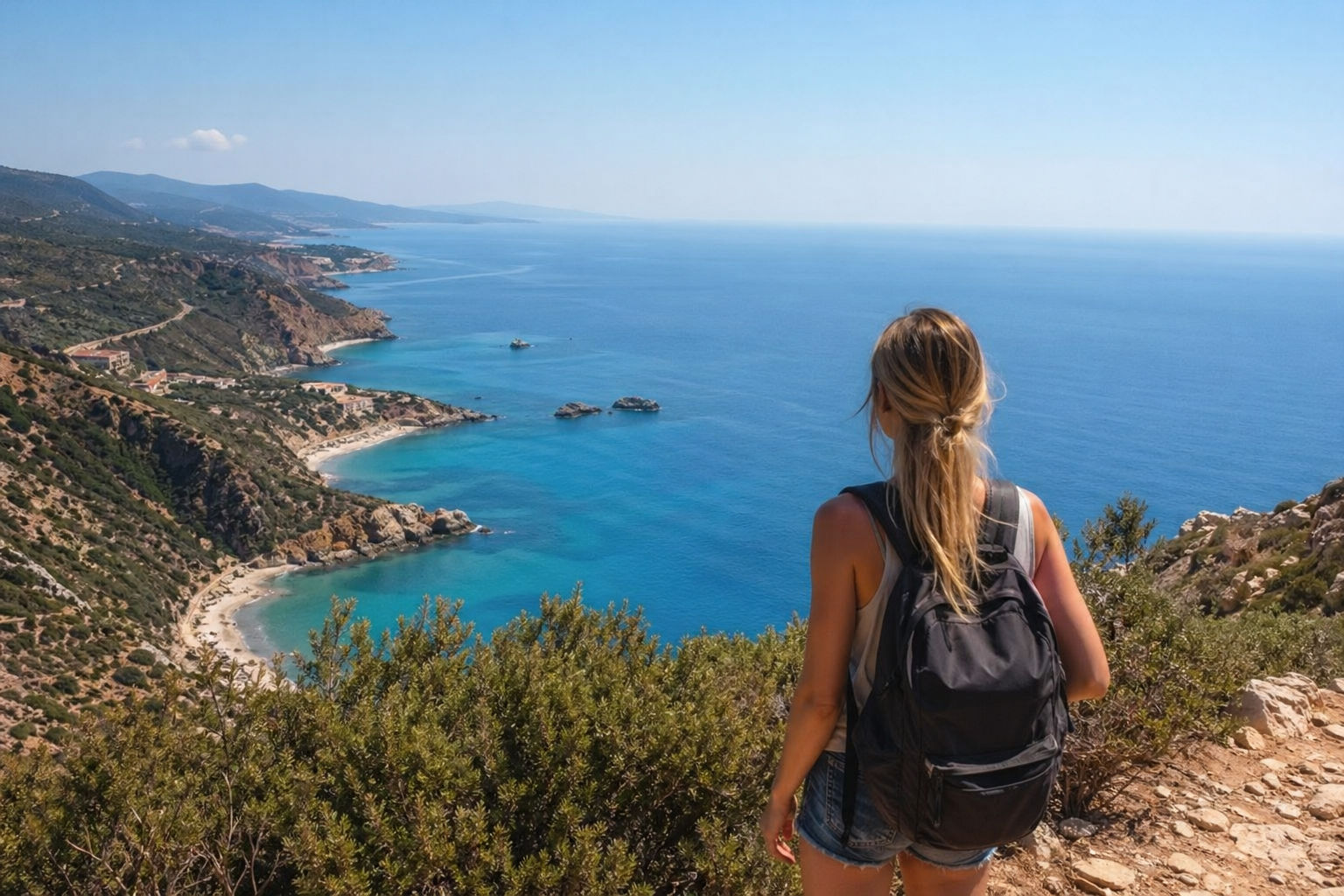
The Aphrodite Trail is the flagship hike of the Akamas and one of the finest coastal walks in Cyprus. Starting from the Baths of Aphrodite, it climbs through dense juniper and mastic forest before emerging on the high ridge above the coast, delivering panoramic views over the peninsula's western cliffs, across Chrysochous Bay to the east, and on clear days all the way to the Turkish coast and the distant outline of Anatolia.
"The trail passes the ruins of the Byzantine monastery of Pyrgos tis Rigainas — a hauntingly atmospheric set of stone walls in the forest."
Practical notes: Difficulty is moderate with sustained uphill in the first half; approximately 380m of total elevation gain. The trail is rocky and exposed in the upper sections — sturdy footwear and sun protection are essential. Carry at least 1.5 liters of water per person; no facilities on route.
The Adonis Trail
The Adonis Trail loops through the opposite side of the ridge from the Aphrodite Trail and descends toward the north coast, with different but equally rewarding views over the Fontana Amoroza bay — a sheltered inlet with turquoise water accessible by boat. The trail passes through the densest section of Akamas forest, where the vegetation transitions from coastal scrub to genuine woodland of mastic, wild olive, Aleppo pine, and the endemic Cyprus golden-drop flower.
The two trails connect at their upper ridge sections, making it possible to combine them into an 11-15km full-day hike that covers the entire heart of the peninsula in a single outing. Most experienced hikers do the combination and call it one of the finest full-day walks in Cyprus.
The Smigies Trail
For visitors who want the Akamas experience without a full-day commitment, the Smigies Trail offers the best value for time of any trail in the park. Starting from the Smigies picnic site 2.5km from Neo Chorio village, it loops through forest with excellent views over Lara Bay to the west and Chrysochous Bay to the east, passing old magnesium mine workings and abandoned lime kilns that tell the pre-tourism industrial history of the peninsula.
Starting point: The Smigies picnic site has a car park, basic facilities, and trail maps. It's accessible by standard car rather than 4x4 and is the most practical starting point for visitors without a high-clearance vehicle.
Avakas Gorge
Avakas Gorge is the Akamas's most dramatic natural feature and one of the geological highlights of the entire island. A canyon carved by a seasonal river through the limestone plateau, Avakas reaches walls of 30 meters in height and narrows to barely two meters wide in its tightest sections. Walking through it involves wading across the (usually shallow) stream several times, scrambling over boulders, and squeezing through rock passages where the canyon walls close in overhead.
"The payoff — standing in a 30-meter slot canyon that narrows to the width of your shoulders — is one of the most genuinely impressive experiences in Cyprus."
Getting there: The gorge entrance is 3 kilometers from Agios Georgios village on the western coast, accessed by a rough track. A standard rental car can usually manage the track but check conditions after rain — it can become soft.
Lara Bay & Turtle Conservation
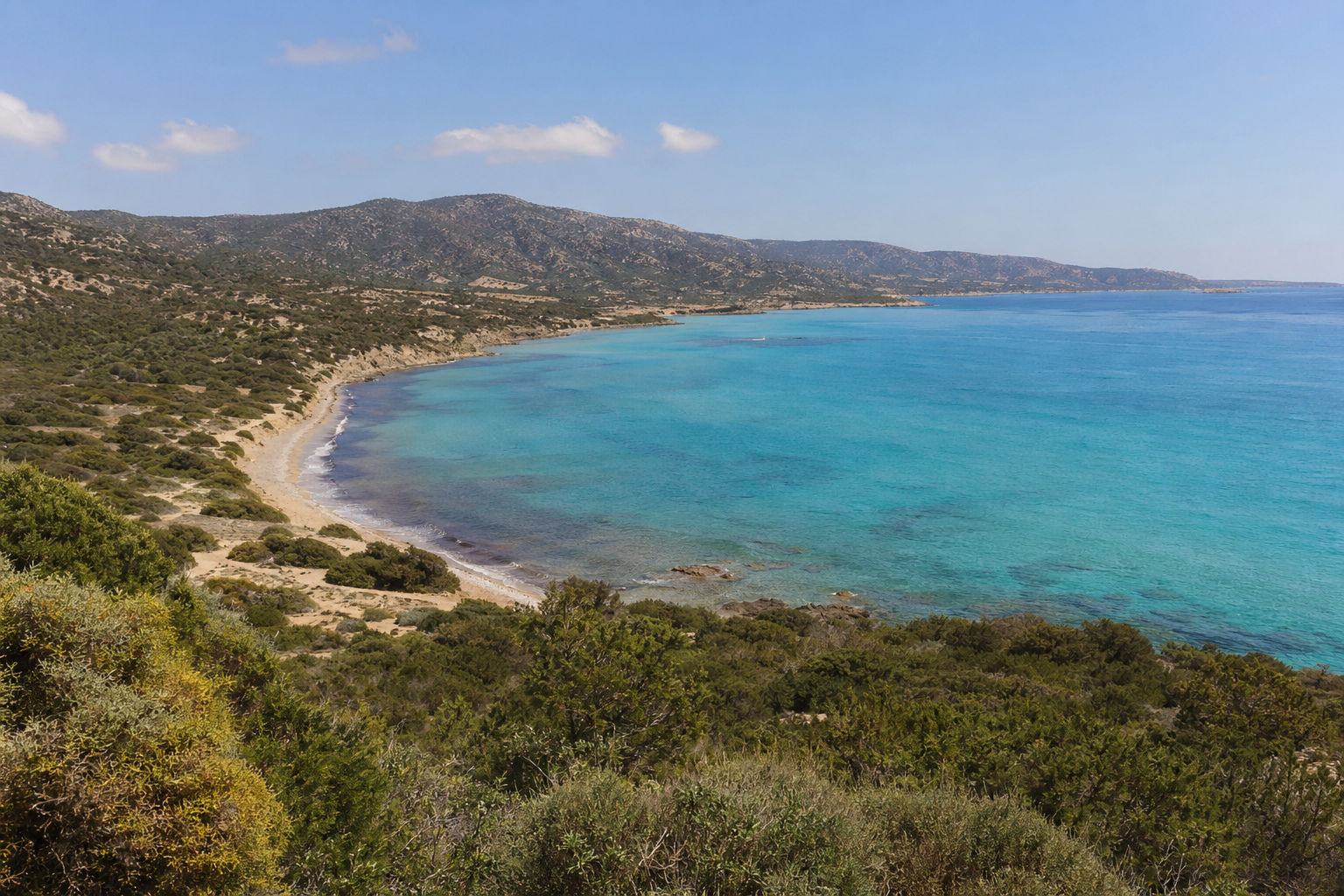
Lara Bay is the most important sea turtle nesting beach in Cyprus and one of the most critical nesting sites for loggerhead and green sea turtles in the entire eastern Mediterranean. The bay is a 2.5-kilometer arc of golden sand backed by coastal scrubland, accessible only by a rough 4x4 track from the Akamas plateau or by boat — which keeps it in a beautifully undeveloped state.
The Lara Bay Turtle Conservation Station, operated by the Department of Fisheries and Marine Research, has been protecting nests and monitoring the turtle population since the late 1970s. Conservation staff are present on the beach from May through October — the nesting and hatching season.
- Nesting season: May through August — female turtles come ashore at night to excavate nests in the sand; guided night tours to observe nesting (from a respectful distance) are run by conservation operators
- Hatching season: August through October — the best time to witness hatchlings emerging from nests and making their way to the sea; the station marks nest locations with signs so visitors can avoid disturbing eggs
- Visiting rules: no artificial light at night, no loud noise, no vehicles on the beach, minimum approach distance maintained at all times; the station staff enforce these actively and respectfully
- The beach in daylight: entirely beautiful outside of conservation-restricted zones; swimming from the beach is allowed in the sections not immediately adjacent to marked nests
Access: A 4x4 is required for the overland track from Neo Chorio or Agios Georgios to Lara Bay. The alternative is a boat trip from Latchi harbour, which many visitors find the more enjoyable approach — the coastal cliffs from the sea are extraordinary.
The Blue Lagoon
The Blue Lagoon inside the Akamas National Park is one of the most spectacularly colored swimming spots in the entire Mediterranean — a sheltered double bay where the water runs from turquoise over the sandy shallows to deep cobalt in the channel, enclosed by limestone cliffs and visible from the Adonis Trail viewpoint above.
The lagoon is not accessible by road — the only way to reach it is on foot from the Baths of Aphrodite (approximately one hour on the Aphrodite or Adonis trail) or by boat from Latchi harbour. The boat option (30 minutes from Latchi) is the most popular approach in summer and allows swimming time in the lagoon before returning; trips typically run €15-25 per person and include snorkeling equipment.
Fontana Amoroza, a smaller bay 500 meters west of the Blue Lagoon, is accessible by the same boat trips and offers slightly less turquoise but significantly less crowded swimming in peak season.
Latchi & Neo Chorio
Most Akamas visitors base themselves in or near Latchi, the small fishing harbour town at the southeastern edge of the peninsula that acts as the main departure point for boat trips and the most convenient overnight base for multi-day exploration.
Latchi has a compact waterfront of fish restaurants, boat charter operators, and a small sandy beach at the harbour edge. The freshest seafood on this part of the coast is served here — whole fish grilled over charcoal, grilled octopus, and the full Cypriot fish meze at prices that are meaningfully lower than Paphos.
Neo Chorio, 5 kilometers inland and uphill from Latchi, is a traditional Cypriot hill village that has retained its stone-built character and is a significantly more atmospheric overnight base than the resort-facing Latchi waterfront. Several guesthouses in Neo Chorio have been converted from traditional houses and offer the kind of quiet, genuinely local village experience that is disappearing from more tourist-heavy parts of the island.
Wildlife Encounters
The Akamas is the best location in Cyprus for wildlife encounters at close range:
- Cyprus mouflon — the endemic wild sheep of Cyprus, a protected species; most reliably spotted in the early morning on the inland trails and forest tracks of the upper peninsula
- Blunt-nosed viper — Cyprus's only venomous snake; found throughout the peninsula; rarely encountered but worth being aware of in scrubland; not aggressive unless stepped on
- Eleonora's falcon — migrating through the peninsula in autumn; the Akamas cliffs are one of the best raptor watching spots in Cyprus
- Common chameleon — endemic subspecies; found in the scrubland and garigue of the lower peninsula
- Peregrine falcon, bonelli's eagle, and griffon vulture — all resident or regular visitors to the upper ridge trails
- Loggerhead and green sea turtles — nesting on Lara Bay from May through October; occasionally sighted by swimmers in the Blue Lagoon and offshore waters
- Wild orchids — over 40 species of orchid bloom across the peninsula from February through April; the Akamas is one of the finest orchid-watching locations in the eastern Mediterranean
Getting Around
A car is essential — there is no public transport to or within the Akamas Peninsula. The main access roads from Paphos pass through Coral Bay and Agios Georgios on the western coastal road, or through Polis and Latchi on the northern approach.
For access to Lara Bay and the deep interior tracks, a 4x4 is strongly recommended. Standard rental cars manage most access roads to the Baths of Aphrodite, Avakas Gorge, and the Smigies trailhead. The rough interior tracks beyond Agios Georgios toward Lara Bay are genuinely rough after rain and can ground a low-clearance vehicle.
- From Paphos to Baths of Aphrodite: approximately 38km, 45 minutes via the coastal road
- From Paphos to Latchi: approximately 43km, 50 minutes
- From Limassol to Baths of Aphrodite: approximately 120km, 1.5 hours
- From Nicosia to Baths of Aphrodite: approximately 175km, 2 hours
Best Times to Visit
- March through May — the finest season; wildflowers peak in March-April, temperatures ideal for hiking (18-24°C), orchids blooming on the lower slopes, sea turtle nesting beginning in May; no summer crowds
- September and October — sea turtle hatching season (August-October), sea temperature still warm for swimming (23-25°C), hike temperatures comfortable, and the August peak crowd completely gone
- November through February — the quietest period; cool hiking weather (12-18°C), no crowds, almond blossom in January-February; some boat operators and smaller visitor facilities close for winter but trails and major sites are accessible year-round
- July and August — peak season; hot (28-35°C), trails uncomfortable by 10am, Lara Bay boat trips and Blue Lagoon tours very busy; go early (7-8am) for trails if visiting in summer
Planning Your Visit
One day from Paphos:
Drive to the Baths of Aphrodite, walk the Aphrodite Trail (3 hours), swim at the Blue Lagoon reached by boat from the trail or from Latchi, seafood lunch at Latchi harbour, afternoon drive through Neo Chorio and return via the Polis coastal road.
Two days based at Latchi or Neo Chorio:
Day 1 as above plus evening at Latchi harbour. Day 2: morning walk of the Adonis Trail or full Adonis-Aphrodite combination hike, afternoon boat trip to Fontana Amoroza, visit Avakas Gorge on the drive back south.
Three days (full Akamas immersion):
Add a 4x4 day exploring the interior tracks to Lara Bay (morning visit to the turtle conservation station), swim from the beach, afternoon Smigies Trail from Neo Chorio, sunset from the upper Smigies viewpoint over Lara Bay.
FAQ
What is the best trail in the Akamas Peninsula for beginners?
The Smigies Trail (2.5km short route, under an hour) is the most accessible entry point for families and casual walkers, with views over both coastlines of the peninsula and easy terrain from the Smigies picnic site. For a longer but manageable half-day, the Aphrodite Trail (7.5km) is the classic Akamas experience.
Can you see sea turtles at Lara Bay?
Yes, seasonally. Nesting occurs May through August (females come ashore at night); hatching occurs August through October. The conservation station staff manage visitor access during both windows. A daylight visit to the beach is always possible; guided night nesting-watching tours are run by operators in Paphos during peak nesting season.
Do you need a 4x4 for the Akamas?
For the Baths of Aphrodite, Smigies trailhead, and Latchi harbour — no, a standard car manages fine. For Lara Bay and the interior tracks — yes, a 4x4 is strongly recommended. Standard cars on the Lara Bay track risk grounding, particularly after rain.
How do you get to the Blue Lagoon in the Akamas?
On foot from the Baths of Aphrodite (approximately 1 hour via the Aphrodite or Adonis trail) or by boat from Latchi harbour (approximately 30 minutes; around €15-25 per person including snorkeling equipment). There is no road access.
Is Avakas Gorge suitable for children?
The first kilometer of the gorge is manageable for children over about 10 who are comfortable scrambling and walking in water. The deeper narrows require more agility and confidence with uneven terrain. Bring water shoes or old trainers — you will get your feet wet.
What is the best time of year to visit the Akamas Peninsula?
March through May delivers the best combination of weather, wildflowers, sea turtle season beginning, and manageable hiking temperatures. September and October add sea turtle hatching and comfortable sea temperatures. Summer is the most crowded and hottest period — go early in the day.
The Last Wild Corner of Cyprus
The Akamas Peninsula exists in the same island as Ayia Napa's nightclubs and Paphos's resort hotels, and it might as well be on a different continent. This is the Cyprus that existed before the first tourist charter flight — rocky, forested, mythological, and alive in a way that no resort coastline can replicate. Sea turtles that predate the tourism industry nest here every summer. Orchids that exist nowhere else on earth bloom here every spring. The cliffs above the Blue Lagoon have been here since before the first temples were built to Aphrodite on the shore below. Spending two days in the Akamas is not a detour from a Cyprus holiday. For many travelers, it becomes the reason they came.
Explore more Cyprus travel guides on IsleRush, including our Troodos Mountains guide, winter Cyprus guide, and North Cyprus travel guide.