Whale and Dolphin Watching in the Canary Islands: Which Island, Which Season
Few things beat the moment a pilot whale surfaces alongside your boat, close enough to hear it breathe. The Canary Islands are one of the best places in the world to make that happen. Unlike most whale watching destinations, you don't need to time your trip perfectly — because for some species, every single day is a good day. That said, knowing which island to choose and which season aligns with what you want to see will make the difference between a decent boat trip and something genuinely unforgettable.
World-Class Cetacean Destination
The islands sit at a geographical sweet spot. The deep Atlantic ocean floor drops rapidly around the archipelago, creating underwater canyons and channels that concentrate food sources and support both resident and migratory whale and dolphin populations year-round. One of the most important of these is the canyon between Tenerife and La Gomera, which reaches depths of 1,000 to 1,200 metres and is home to an estimated 400 resident pilot whales.
"The range makes this archipelago genuinely exceptional — not just for casual tourists wanting a nice boat trip, but for serious wildlife travellers who want to see multiple species across a single holiday."
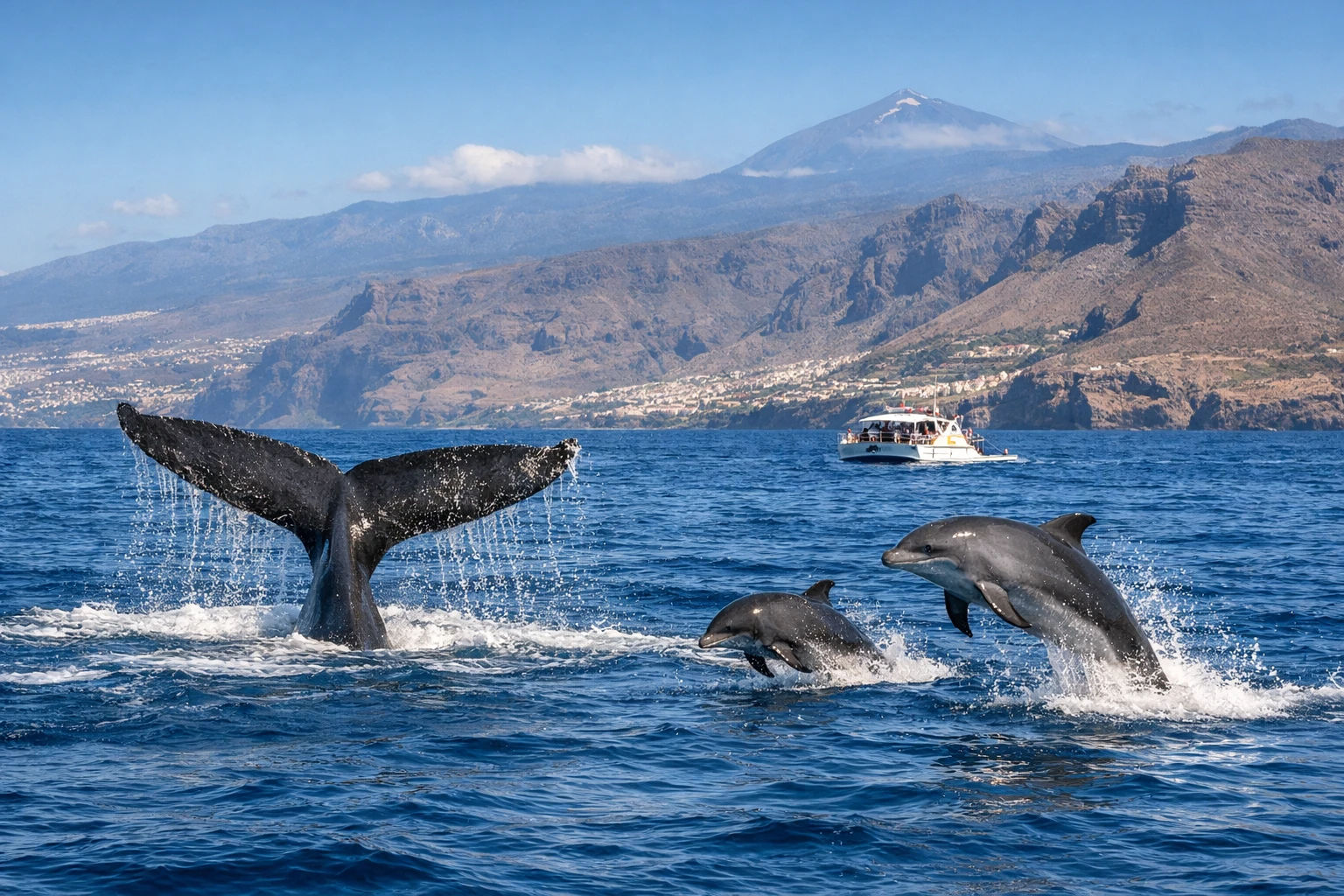
In total, over 30 species of cetacean have been recorded in the waters of the Canary Islands, including bottlenose dolphins, short-finned pilot whales, sperm whales, Bryde's whales, fin whales, humpback whales, and on rare extraordinary occasions, blue whales.
What You Can See
Understanding which species are resident and which are migratory helps you set realistic expectations and plan your timing:
Resident year-round species:
- Short-finned pilot whales — seen on 99% of Tenerife tours and present around La Gomera and Gran Canaria daily
- Bottlenose dolphins — sighted on over 70% of tours in Tenerife; also reliably seen around Lanzarote and La Gomera
- Bryde's whales — a lesser-known resident of the archipelago, spotted on a portion of tours year-round
- Sperm whales — a true resident of the Canary Islands, spotted several days per month in deep water channels
Seasonal and migratory species:
- Humpback whales — best chance November to April
- Fin whales — November to February, especially in deeper water
- Common dolphins — more frequent during spring migrations, March to May
- Orca (killer whales) — occasional sightings, typically linked to summer tuna migrations
Island by Island
Tenerife — The Best Overall Base
Tenerife is the undisputed top choice for whale and dolphin watching in the Canary Islands, and the numbers back that up. The resident pilot whale population between Puerto Colón, Costa Adeje, and Los Gigantes is one of the densest in the world, and commercial tour operators report pilot whale sightings on virtually every single departure.
The best departure points on the island are:
- Los Gigantes — deep water reaches right up to the base of the cliffs here, making it exceptional for pilot whales and bottlenose dolphins; smaller boats give a more personal experience
- Puerto Colón (Costa Adeje) — the main hub for whale watching tours, with the highest number of daily departures and a range of boat sizes
- Los Cristianos — alternative departure point with good access to the Tenerife-La Gomera channel
"Morning tours generally offer calmer sea conditions and lower boat traffic, which increases the chance of prolonged sightings."
Late afternoon tours trade calm for golden light and can be spectacular for photography.
La Gomera — The Specialist's Choice
La Gomera is smaller, less commercial, and runs far fewer tours — but the quality of the experience is arguably higher than anywhere else in the archipelago. The waters off Valle Gran Rey on the island's west coast are among the least disturbed whale watching waters in the Canaries, and the species diversity here in spring regularly outperforms every other island.
In the peak months of February through May, sighting probability on La Gomera reaches up to 99%, with species diversity at its highest. You're most likely to encounter:
- Short-finned pilot whales
- Atlantic spotted dolphins
- Common bottlenose dolphins
- Bryde's whales
- Migratory fin whales and humpbacks in February and March
The crossing from Los Cristianos in Tenerife takes around 50 minutes by fast ferry, so combining a La Gomera day trip with whale watching is a genuinely excellent Canary Islands day.
Gran Canaria — Convenient and Underrated
Gran Canaria rarely makes the top of whale watching lists, but it absolutely should be on the radar. Daily tours depart twice a day from the southwest coast, typically from Puerto de Mogán and Puerto Rico, sailing into the channel between Gran Canaria and Tenerife.
"For travellers based in Las Palmas or the southern resorts who don't want to island-hop for their wildlife experience, Gran Canaria delivers strong results with very convenient access."
The resident pilot whale and bottlenose dolphin populations here are well-established, and Atlantic spotted dolphins are common sightings during warmer months.
Lanzarote — Dolphins and Surprising Encounters
Lanzarote's whale watching scene centres on the waters around Los Lobos, the small island just off Fuerteventura, and the strait between Lanzarote and the African coast. Bottlenose dolphins are the most consistent sighting here, often encountered in large pods around Los Lobos, and pilot whales make appearances in the deeper channels offshore.
Lanzarote also benefits from its proximity to the African coast (just 115 km away), which places it in the path of some interesting seasonal migrations. It isn't the first choice for dedicated whale watching, but for travellers already based there, the dolphin encounters are reliably excellent.
El Hierro — Remote, Protected, and Extraordinary
El Hierro is the smallest and most remote of the main islands, and its waters are some of the most protected in the entire archipelago. The island is ringed by a UNESCO Biosphere Reserve, and the marine environment here is genuinely pristine. Whale and dolphin watching around El Hierro feels nothing like a commercial tour — it's quieter, wilder, and the chance of uncommon encounters (Bryde's whales, beaked whales, sperm whales) is higher than anywhere else in the Canaries.
The catch: El Hierro is harder to reach, with limited flights and fewer daily services. But for wildlife-focused travellers who want an experience rather than an excursion, it's worth every bit of the effort.
La Palma — The Hidden Contender
La Palma is another underrated option for dolphin watching specifically, with tours departing from Tazacorte on the island's west coast recording an 80% sighting rate. Atlantic spotted dolphins and bottlenose dolphins are the most reliable species here. The island's deep coastal waters and low boat traffic make for a relaxed and unhurried experience, particularly well-suited to families and travellers who find the busier tour scene in Tenerife overwhelming.
Seasonal Guide
The Canary Islands offer year-round cetacean watching, but the experience shifts meaningfully across the seasons:
Winter (November to February)
- Best window for migratory baleen whales — humpbacks, fin whales, and occasional sperm whales
- Sea conditions can be choppier, particularly in January and February
- Resident pilot whales and dolphins present as always
- Peak whale watching season for species diversity — the water is cooler but the rewards are real
Spring (March to May)
- Widely considered the best overall season for whale and dolphin watching across all islands
- Sighting probability at its peak, with species diversity highest in March through May
- La Gomera reaches up to 99% sighting rates in this window
- Calm seas, good visibility, and pleasant temperatures make for ideal conditions on the water
- Migratory species still present in March before moving on — common dolphins and Atlantic spotted dolphins join the resident populations
Summer (June to August)
- Resident pilot whales and dolphins present and active
- Baby pilot whales and calves are common sightings in July and August — Tenerife operators call this "baby season" and it's genuinely special
- Occasional orca sightings tied to tuna migrations
- Sea conditions are at their calmest and most reliable
- Migratory baleen whales have moved on, but the experience remains excellent
Autumn (September to November)
- Another strong season with species diversity picking back up as migration begins again
- October and November bring an increase in humpback and fin whale activity
- Seas are generally calm in September and October, less so by November
- One of the most underrated windows for whale watching given lower crowd levels
Choosing the Right Tour
A few things worth knowing before you book:
- Small boats vs. catamarans — small boats get closer and feel more immersive; catamarans are more stable and better for anyone prone to seasickness
- Responsible operators — look for tours certified under the CERT (Canarian Whale Watching Certificate) scheme, which means the operator follows strict approach guidelines that don't disturb the animals
- Tour duration — most tours run 2 to 3 hours; anything shorter limits the quality of the experience
- Guaranteed sighting policies — most reputable operators in Tenerife offer a free repeat trip if pilot whales aren't sighted, though this is rarely needed
- Best time of day — morning departures offer calmer water and less boat traffic; afternoon departures offer better light for photography
FAQ
What is the best island for whale watching in the Canary Islands?
Tenerife is the best overall base for whale watching due to its large resident pilot whale population and the highest frequency of daily tour departures. La Gomera offers the best species diversity in spring, with sighting rates reaching up to 99% in March and April.
Can you see whales in the Canary Islands year-round?
Yes. Resident pilot whales and bottlenose dolphins are present every month of the year. Tenerife tour operators report pilot whale sightings on 99% of all departures regardless of season. Migratory species like humpbacks and fin whales are most reliably seen from November to April.
What is the best time of year for whale watching in the Canary Islands?
Spring (March to May) is the best overall season for species diversity and sighting probability. Winter (November to February) is the best window for migratory baleen whales including humpbacks and fin whales.
How much does a whale watching tour cost in the Canary Islands?
Tour prices typically range from €30 to €60 per adult depending on boat type, duration, and operator. Smaller specialist tours cost more; larger catamaran group tours sit at the lower end of that range.
Is whale watching in the Canary Islands ethical?
The Canary Islands have a formal cetacean protection framework, and many operators are certified under the CERT whale watching scheme which enforces responsible approach distances and behaviour guidelines. Choosing a certified operator is the simplest way to ensure your tour supports rather than disrupts the animals.
Are dolphins or whales more commonly seen?
Both are consistently sighted. On Tenerife tours, pilot whales are seen 99% of the time and bottlenose dolphins over 70% of the time. In practical terms you are more likely to leave having seen both than just one.
The Ocean Is Already Waiting
The Canary Islands sit above one of the richest cetacean habitats on the planet, and unlike almost anywhere else in Europe, you don't need to cross your fingers and hope. Pilot whales are there every day of the year. Dolphins are there most days. Spring brings the kind of species diversity that wildlife travellers fly across the world for. Whether you choose the commercial efficiency of Costa Adeje, the wild quietness of El Hierro, or the extraordinary spring season off La Gomera, the Canary Islands offer a whale and dolphin watching experience that few destinations anywhere on earth can match. Book the morning tour, get out on the water, and see for yourself.
Explore more Canary Islands travel guides, or read our seasonal guide to plan the perfect island trip.