Tour des Yoles Rondes de Martinique 2026: The 40th Anniversary of the Caribbean's Most Spectacular Sailing Tradition
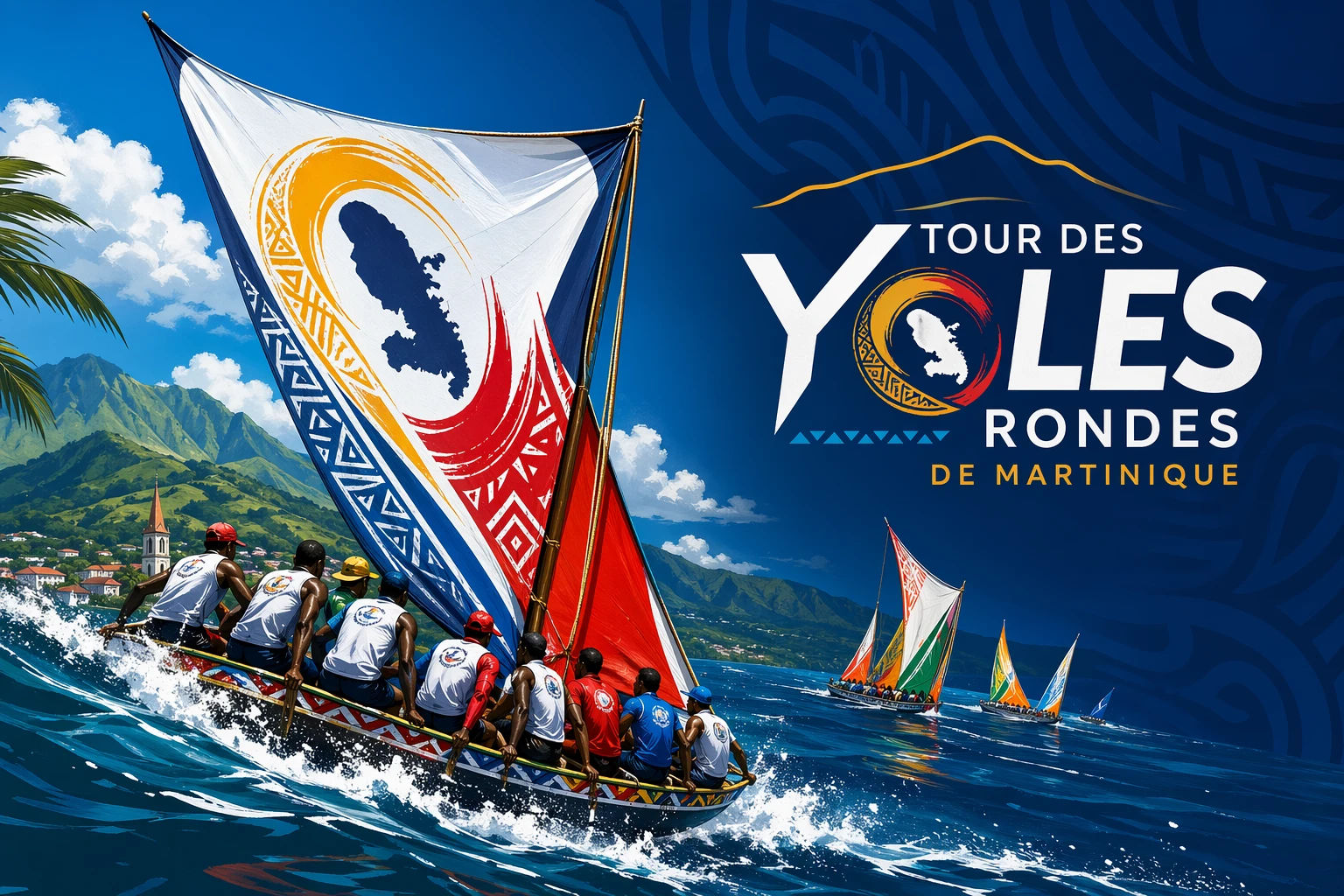
There is a moment, repeated at every stage of the Tour des Yoles Rondes de la Martinique, that stops everyone on the beach. The yoles come in from the sea, those impossibly slender, vividly painted traditional sailing boats with their crews of 10 or 11 sailors balanced on the outrigger beams like acrobats, leaning out over the wave tops to counterbalance the enormous sail pressure, flying across the water at speeds that seem to defy the physics of what is essentially a wooden fishing boat. And the entire coast of Martinique stops what it is doing and watches.
The 40th edition of the Tour de Martinique des Yoles Rondes runs from Sunday, July 26 to Sunday, August 2, 2026. Eight stages. Eight days. An entire island circumnavigated in traditional wooden boats that have been described by UNESCO as an Intangible Cultural Heritage. A race that AZ Martinique calls "the most popular event of the year, along with Carnival." And a 40th anniversary edition that will be unlike any that came before, because the Fédération des Yoles Rondes de la Martinique (FYRM) has confirmed that this milestone edition will be dedicated to the memory of Georges Brival, the visionary founder of the Tour, who passed away in January 2024, and Alain Dédé, another emblematic figure of the yole ronde tradition.
"Forty years. One island. The most extraordinary traditional sailing spectacle in the Caribbean. And 2026 is the year it comes of age."
The Yole Ronde: A Cultural Icon
Before you can understand the Tour des Yoles Rondes, you need to understand the yole ronde itself, because this is not simply a boat. It is a cultural object with a history as layered as the island it was built to navigate.
The yole ronde (literally "round boat") was developed by the fishing communities of Martinique from African boat-building traditions brought to the island with enslaved people, adapted over generations to the specific conditions of the Martinique coast: the trade winds, the coral reefs, the deep Atlantic swells of the east coast, and the calmer Caribbean waters of the west. The round-hulled design, narrow and low in the water, is extraordinarily fast in the right conditions but demands a specific and highly skilled crew technique to keep upright under the large sail area that gives it its speed.
The modern racing yole, while descended from the traditional fishing vessel, is a specialised competition machine:
- Hull length: Approximately 9 to 10 metres, narrow-hulled with a flat bottom
- Crew: 10 to 11 sailors, typically including a helmsman (le barreur), a sail handler (le marnier), and the outrigger crew (les hommes de lof) who hang their body weight off long wooden beams to counterbalance the sail
- Sail: A single large sail of approximately 50 to 70 square metres, generating extraordinary power relative to the boat's weight
- Outriggers (les lofs): The long wooden poles that extend from the boat's hull, which the crew hang from to counterbalance the heeling force of the sail, creating the acrobatic visual spectacle that defines the yole ronde's appearance at speed
- Construction: Traditional wooden construction, with each boat associated with a specific commune of Martinique and often carrying the name and livery of a major sponsor prominent on the sail
Between 13 and 20 yoles compete in each Tour, representing the island's major communes and their associated corporate sponsors, with the rivalry between boats being simultaneously a sporting competition and a community identity contest. Each boat represents more than its crew. It represents a village, a community, a stretch of Martinique coastline, and the pride of the people who grew up watching it race.
40 Years of History
The Tour de Martinique des Yoles Rondes was founded in 1985 by Georges Brival, the man the FYRM has confirmed will be honoured at the 40th anniversary edition as the visionary who saw in a traditional fishing boat the potential for an island-wide sporting and cultural event that would bring all of Martinique together.
"Brival's insight was simple but radical: take a boat that every coastal community in Martinique already knew and loved, create a race format that visited those communities in sequence as the boats circumnavigated the island, and give each stage the character of a village fête rather than a purely sporting event."
The race grew, year by year, into exactly what Brival had imagined: the most watched sporting event in Martinique, and one of the most culturally significant events in the French Caribbean. It acquired UNESCO recognition as a component of the island's Intangible Cultural Heritage. It became the anchor event of Martinique's summer calendar, around which the rest of the August cultural programme organises itself. It gave the island a shared identity that transcended the distinctions between north and south, coast and interior, city and village.
Georges Brival died in January 2024, two years before the 40th anniversary he spent his life building toward. The FYRM's decision to dedicate the 2026 edition to his memory, alongside fellow pioneer Alain Dédé, ensures that the anniversary is both a celebration and a tribute: forty years of racing in the name of the man who understood what a boat could mean to an island.
The 2026 Race Format
The 40th Tour des Yoles Rondes runs from July 26 to August 2, 2026, covering eight daily stages that take the fleet from a southern starting point clockwise around the island's coast to the finish at Fort-de-France.
"The FYRM confirms that the detailed stage-by-stage route for 2026 will be communicated to participants and the public in advance of the race."
Based on the established format of the 39th edition in 2025 (which followed the route of Le Diamant to Fort-de-France via the south and east coast to the north and back), the typical 2026 stage structure follows the pattern of:
- Stage 1 (Sunday, July 26): Southern departure point, typically Le Diamant or a similarly iconic southern bay, setting the tone for the race with the entire fleet launching into the Caribbean Sea in what is consistently one of the most spectacular sailing starts anywhere in the world
- Stage 2 and 3 (Monday-Tuesday): The south coast and Atlantic south-east, through Rivière-Pilote, Sainte-Anne, and Le Vauclin, with the Atlantic swell of the east coast providing the most challenging and most dramatic racing conditions of the entire tour
- Stage 4 (Wednesday): Le Vauclin to Le François, the athletic and popular mid-race stage on the central Atlantic coast
- Stage 5 (Thursday): Le François to Sainte-Marie on the northern Atlantic coast
- Stage 6 (Friday): Sainte-Marie to Saint-Pierre, the most historically charged stage of the race, arriving at the ruined city destroyed by Mount Pelée in 1902
- Stage 7 (Saturday): Saint-Pierre to Fort-de-France, the penultimate stage bringing the fleet down the Caribbean coast to the capital
- Stage 8 (Sunday, August 2): Fort-de-France conclusion and final ceremony, with the prize-giving and celebrations confirming the winner of the 40th Tour
The full confirmed stage route for 2026 will be published at tourdesyoles.com and through the FYRM's official channels.
Watching the Race
The Tour des Yoles Rondes is a race, but the experience of watching it from the finish beach is the experience of a Caribbean village fête that happens to involve some of the most breathtaking sailing you will ever see.
"Each stage finish is an event in itself. The arrival village on any given day of the tour prepares for days in advance, setting up food stalls, sound systems, and the gathering infrastructure for the thousands of people who follow the race around the island's coast."
What the race experience offers at each stage finish:
- The arrival: The yoles come into the finish beach at speed, sails fully set, crews hanging from the outrigger beams in the acrobatic position that is uniquely yole ronde, and the crowd on the beach responds to each boat's arrival with noise and energy proportionate to how closely contested the stage has been. When two yoles are fighting for a stage win on the final downwind run to the beach, the sound from the crowd is heard across the whole bay.
- The village atmosphere: Once the racing boats are ashore, the finish beach transforms into a street party. Sound systems playing Martinican music, food stalls selling grilled fish, fried plantain, accras de morue (salt cod fritters), and the full range of Creole street food, rum punch flowing, and the crews of the competing boats mingling with the crowd that has followed them around the coast.
- The informal podium: Each stage winner is celebrated with the particular intensity of a community event, because in most cases the winning boat represents a commune on the island and its victory is the commune's victory. The celebration is genuine and total.
- The overnight before the next stage: Between stages, the race fleet is transported or sails to the next starting point while the support crews, families, and the following crowd move on to the next village. The culture of following the Tour across multiple stages is deeply embedded in Martinican life, with many islanders attending four, five, or all eight stages each year.
The Cultural and Natural Setting
The Tour des Yoles Rondes uses the entire coastline of Martinique as its racecourse, and the variety of sailing conditions, landscapes, and communities that the island provides across its perimeter makes it one of the most naturally suited venues for a traditional sailing regatta anywhere in the world.
"The race passes through settings that are among the most beautiful in the Caribbean."
The race passes through settings that are among the most beautiful in the Caribbean:
- Le Diamant and the Rocher du Diamant (Diamond Rock): The southern Caribbean coast where the starting area is typically set against the backdrop of the 175-metre volcanic rock that protrudes from the sea off the village of Le Diamant, declared a "ship" by the British Royal Navy in the early 19th century and still one of the most dramatic natural landmarks in Martinique
- The Atlantic coast of the south-east: From Sainte-Anne to Le Vauclin, the wild Atlantic coastline where the trade wind swells provide the fastest and most technically demanding sailing of the tour, with the boats racing through turquoise water over volcanic sand with the Martinique hills as the backdrop
- Le François and its white sand islands: The inland bay of Le François, dotted with white sand islets surrounded by crystal-clear shallow water, is one of the most photographed natural environments in Martinique and provides a unique stage setting unlike anywhere else on the course
- Saint-Pierre: The city that was destroyed by the eruption of Mount Pelée on May 8, 1902, killing approximately 30,000 people in minutes and leaving the former capital in ruins. The arrival of the yoles at Saint-Pierre, with the ruins visible on the shore and the volcano visible above the town, is one of the most historically charged moments of the entire race.
- Fort-de-France: The capital city's waterfront, fronted by La Savane park and the statue of the Empress Joséphine, provides the final arrival setting for the race's concluding stages and the prize-giving ceremony
Practical Information for Visitors
Confirmed 2026 Race Details:
- Edition: 40th (anniversary edition)
- Dates: Sunday, July 26 to Sunday, August 2, 2026
- Format: Eight daily stages circumnavigating Martinique
- Organiser: Fédération des Yoles Rondes de la Martinique (FYRM)
- Entry: Watching the race from finish beaches is free (no ticketing required)
- Official Website: tourdesyoles.com
- FYRM Official Site: federationdesyolesrondes.org
Stage route: Detailed 2026 stage-by-stage route to be officially published at tourdesyoles.com ahead of the July 26 start.
How to follow the race:
The best way to experience the Tour des Yoles is to choose one or more stage finish villages and be at the beach for the arrivals:
- Check the official stage schedule at tourdesyoles.com as soon as the full programme is published (typically late June or early July)
- Arrive at the finish village 1 to 2 hours before the expected boat arrivals to secure a viewing position on the beach and to participate in the pre-arrival village atmosphere
- The most popular stages for visitors are typically the Fort-de-France stages (easiest access, largest crowd) and the Saint-Pierre stage (most dramatic natural and historical setting)
- The Le François stage and the Sainte-Anne stages are particularly beautiful and less crowded than the capital stages, making them excellent choices for visitors who want a more immersive community experience
- Food and drink are available from village vendors at every stage finish throughout the race week
Getting around Martinique during the race:
- Hire car is the most practical option for following the race across multiple stages, as the tour passes through towns spread across the entire island perimeter
- Martinique Aimé Césaire International Airport (FDF) is the arrival hub, near Fort-de-France, from which all stage towns are reachable within 45 minutes to 1 hour by car
- The stage towns are connected by the island's coastal road network; GPS navigation to each village centre or seafront is straightforward
Accommodation during the Tour:
The race week in late July and early August is the most popular week of the year in Martinique. Accommodation, particularly in the most popular stage towns (Fort-de-France, Sainte-Anne, Le Marin, Sainte-Marie), books up many months in advance.
- Fort-de-France: Broadest range of accommodation, most central for following multiple stages
- Les Trois-Ilets and Anse Mitan: Resort peninsula opposite Fort-de-France with beach hotels, ferry access to the capital, and a relaxed base for the race week
- Le Marin and Sainte-Anne: The southern sailing hub with excellent access to the early stages and the first Atlantic coast stages
- Sainte-Marie (Atlantic coast): The northern Atlantic coast base for the later stages and a beautiful historic town in its own right
Frequently Asked Questions
When is the Tour des Yoles Rondes 2026 in Martinique?
The 40th Tour de Martinique des Yoles Rondes runs from Sunday, July 26 to Sunday, August 2, 2026. The race covers eight daily stages circumnavigating the island of Martinique. The detailed stage-by-stage route will be published at tourdesyoles.com.
What is a yole ronde and why is it unique to Martinique?
A yole ronde is a traditional Martinican sailing boat descended from wooden fishing vessels developed by the island's coastal communities. It is approximately 9 to 10 metres long with a single large sail, crewed by 10 to 11 sailors who balance on wooden outrigger beams to counterbalance the sail pressure. The acrobatic crew technique and the speed of the boats at full sail are unique to Martinique and have earned UNESCO Intangible Cultural Heritage recognition.
Is it free to watch the Tour des Yoles Rondes?
Yes. Watching the race from the finish beaches at each stage is completely free. The village atmosphere, food stalls, and celebrations at each finish are also free, though food and drink vendors charge normal prices.
Why is the 2026 edition of the Tour des Yoles Rondes special?
The 2026 edition is the 40th anniversary of the race, which was founded in 1985 by Georges Brival, who passed away in January 2024. The FYRM has confirmed that the 40th edition will include a solemn tribute to Brival and to Alain Dédé, another pioneer of the yole ronde tradition, making the 2026 race a historic commemoration as well as an anniversary celebration.
How many boats compete in the Tour des Yoles Rondes?
Between 13 and 20 yoles rondes compete in each Tour, representing the island's major communes and their associated corporate sponsors. Each boat is identified by the sponsor name on its sail and by its commune association, with fierce inter-community rivalry adding intensity to the purely sporting competition.
What other major events coincide with the Tour des Yoles Rondes 2026?
The Baccha Festival 2026 (Martinique's biggest beach music festival) runs August 7 to 9, 2026 at Pointe Faula, Le Vauclin, immediately after the Tour ends on August 2. Le Vauclin is also a stage finish village on the Tour route, making it one of the most natural festival combinations in the Caribbean: the Tour des Yoles during the race week, the Baccha Festival the weekend after, all in the same Atlantic coast community.
Forty years of tradition. Forty editions of the race that Georges Brival dreamed up and gave to an island that needed exactly this: a week each summer when every village on the coast is a destination, every beach is a stage, and every Martinican, wherever they grew up and wherever they live now, has a reason to come back to the sea.
The 40th Tour de Martinique des Yoles Rondes runs July 26 to August 2, 2026. The full stage route will be published at tourdesyoles.com. Book your accommodation in Martinique now, before the best places for the race week are gone. And when the fleet arrives at your stage finish beach, you will understand immediately why this island calls this its greatest event.
Verified Information at a Glance
- Event Name: 40th Tour de Martinique des Yoles Rondes (Tour des Yoles Rondes de Martinique 2026)
- Event Category: Annual Traditional Sailing Regatta and Cultural Festival (UNESCO Intangible Cultural Heritage)
- Edition: 40th Anniversary (Founded 1985 by Georges Brival)
- Dates: Sunday, July 26 to Sunday, August 2, 2026
- Duration: 8 days, 8 stages
- Format: Circumnavigation of Martinique by traditional yole ronde sailing boats
- Starting Location: Southern Martinique (detailed stage route to be published at tourdesyoles.com)
- Finish Location: Fort-de-France (final stage and prize-giving ceremony)
- Number of Competing Boats: 13 to 20 yoles rondes
- Organiser: Fédération des Yoles Rondes de la Martinique (FYRM)
- 2026 Special Tribute: Georges Brival (founder, died January 2024) and Alain Dédé
- Admission: Free (watching from finish beaches)
- Official Website: tourdesyoles.com
- FYRM Website: federationdesyolesrondes.org
- Stage Route for 2026: To be published at tourdesyoles.com in advance of July 26 start
- Concurrent Events: Baccha Festival (August 7 to 9, 2026, Le Vauclin) immediately after the Tour concludes
- Nearest Airport: Martinique Aimé Césaire International Airport (FDF), near Fort-de-France
- FYRM Competition Calendar: federationdesyolesrondes.org/calendrier