
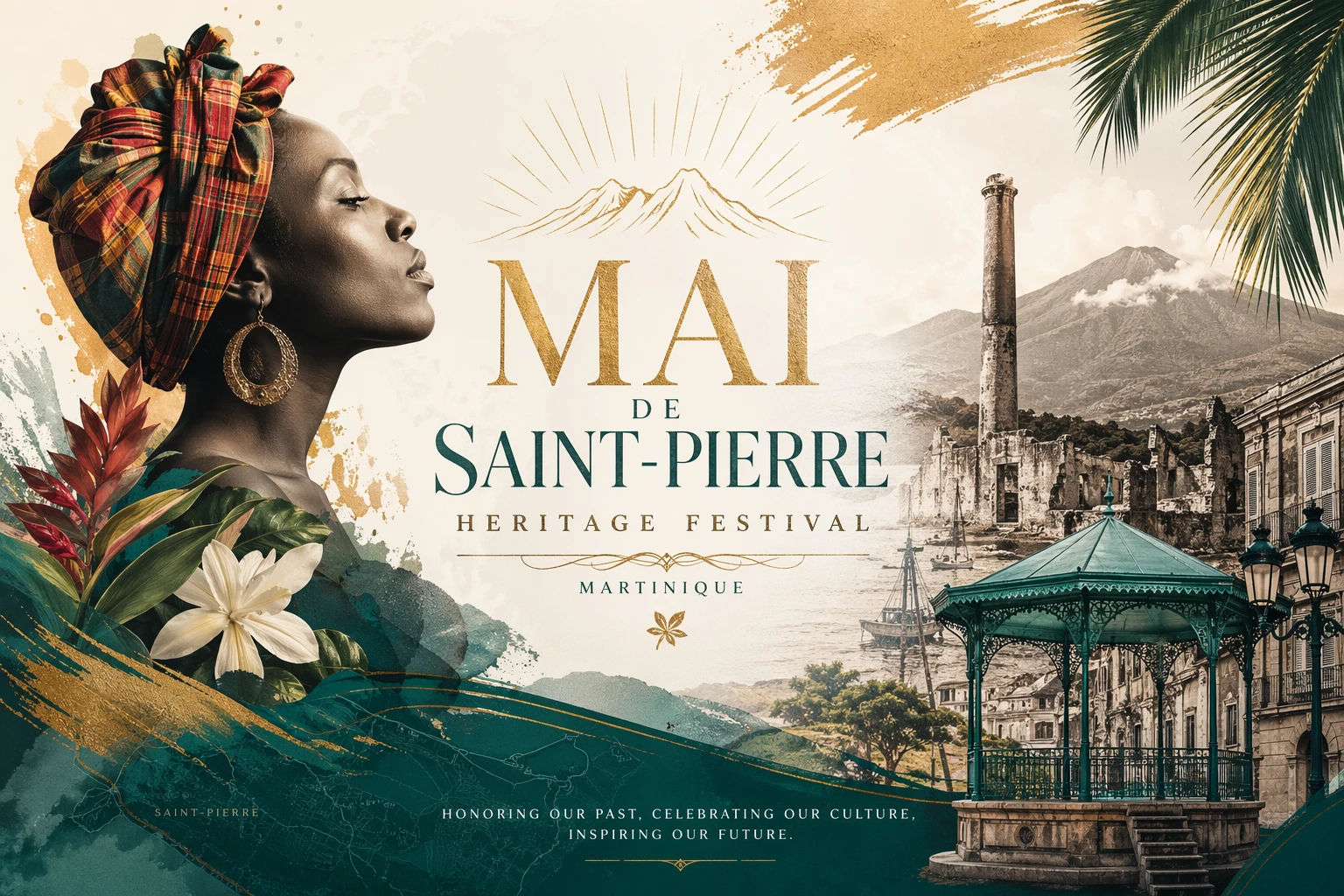
Mai de Saint-Pierre Heritage Festival Martinique 2026: A Month of Memory and Culture
There is a town in Martinique that carries more history per square metre than almost anywhere else in the Caribbean. Before the morning of May 8, 1902, Saint-Pierre was the jewel of the French Antilles: a coastal city of 30,000 people, the cultural and commercial capital of the island, a place that travellers compared to Paris in its sophistication, its theatres, its cafés, and its energy. Martinicans called it "le Petit Paris".
At 7:52 AM on that morning, Montagne Pelée, the volcano that rises immediately behind the town, erupted with a force that had never been documented in the modern era. A superheated pyroclastic cloud descended the mountain at speed. The city of Saint-Pierre was obliterated in under two minutes. The ships in the harbour were sunk or set ablaze. The population died almost entirely. The only confirmed survivor in the city itself was a prisoner named Louis-Auguste Cyparis, protected by the thick walls of his underground jail cell.
"The Mai de Saint-Pierre Heritage Festival is a month-long celebration of the town of Saint-Pierre: its devastating past, its complex history, and its remarkable ongoing life."
The Mai de Saint-Pierre Heritage Festival is a month-long celebration of the town of Saint-Pierre: its devastating past, its complex history as the site of one of Martinique's earliest and most significant slave revolts that led directly to the abolition of slavery on the island, its extraordinary cultural assets, and its remarkable ongoing life as a community that has rebuilt itself in the shadow of the same volcano that destroyed it.
For the entire month of May 2026, Saint-Pierre will be alive with exhibitions, concerts, guided tours, conferences, hikes on the slopes of Montagne Pelée, sports events, and the particular atmosphere of a coastal Caribbean town that knows its history and has chosen to celebrate rather than simply mourn it.
The 2026 edition will be the 51st, following the landmark 50th edition in May 2025.
Mai de Saint-Pierre
A Cultural Festival Like No Other
Mai de Saint-Pierre is an annual month-long heritage and cultural festival organised by the OMNIAC (Office Municipal d'Initiative et d'Actions Culturelles de Saint-Pierre), the municipal cultural organisation of the town of Saint-Pierre, located at 97250 Saint-Pierre, Martinique.
The festival was created to hold space for two of the most significant dates in Martinique's history, both of which fall in May:
May 8: the anniversary of the eruption of Montagne Pelée in 1902 and the destruction of the former capital
May 22: the Commemoration of the Abolition of Slavery in Martinique, marking the day in 1848 when the slave revolt that began in Saint-Pierre forced the Governor of Martinique to declare the abolition of slavery on the island, two days before the official French government decree arrived
"Far from being a simple commemoration, it celebrates the city, its assets, its wealth and its past gluttony."
These two dates could have produced a solemn and largely ceremonial festival. Instead, over 51 editions, Mai de Saint-Pierre has grown into something far more alive: a celebration of the town's cultural richness, its artistic talent, its natural setting, and the community spirit of a place that has every reason to have given up and has consistently chosen not to.
Historical Anchors
May 8 and May 22
The Eruption of Montagne Pelée
The facts of the 1902 eruption of Montagne Pelée are staggering even now, more than 120 years later.
Saint-Pierre in 1902 had a population of approximately 30,000 people and was the largest and most prosperous city in the French Caribbean
The city had a theatre modelled on the Opera House in Bordeaux, a cathedral, a hospital, markets, and a harbour regularly visited by international shipping
At 7:52 AM on May 8, 1902, a nuée ardente (pyroclastic density current) descended from the volcano at speeds estimated up to 670 kilometres per hour at temperatures exceeding 1,000°C
The city was destroyed in under two minutes
Approximately 28,000 to 30,000 people died, making it the deadliest volcanic event of the 20th century
Louis-Auguste Cyparis, a prisoner whose underground cell protected him from the worst of the blast, became one of the most famous survivors in the history of volcanology; his story was performed as the theatrical production "Juste Seul Cyparis" during the 2025 European Heritage Days at Saint-Pierre
The ruins of the town still exist: the theatre, the prison, the distillery, the cathedral walls, the anchor-strewn harbour full of sunken ships, all remain as the most extraordinary open-air archaeological site in the Caribbean
For Mai de Saint-Pierre 2026, May 8 anchors the programme's commemorative heart: guided visits to the ruins, conferences on the geology and history of the eruption, and the collective pause that the community of Saint-Pierre holds each year for a catastrophe that is still within living memory for the oldest families of the town.
The Abolition of Slavery
The second great date of May in Saint-Pierre's history carries equal weight and a completely different emotional register.
On May 22, 1848, enslaved workers in the Saint-Pierre area rose in revolt, forcing the Governor of Martinique to issue an immediate local declaration abolishing slavery on the island. The official French government abolition decree, issued in Paris under Victor Schoelcher, had not yet arrived when the revolt forced the Governor's hand, making Martinique's abolition technically the result of direct action by the enslaved population of Saint-Pierre.
"The Commemoration of the Abolition of Slavery brings the island together: ceremonies, open stages."
This history gives May 22 a particular significance in Martinique's national memory: it is not only the commemoration of abolition but the commemoration of abolition achieved through resistance on the very soil of Saint-Pierre.
The martinique.org 2026 events calendar specifically highlights May 22 as a moment when the entire island comes together: "the Commemoration of the Abolition of Slavery brings the island together: ceremonies, open stages."
During Mai de Saint-Pierre 2026, May 22 will be marked with ceremonies, performances, open-air cultural events, and the specific community solidarity that this date generates in Saint-Pierre and across Martinique.
Festival Highlights
Exhibitions, Concerts, and More
The Mai de Saint-Pierre programme runs across the entire month of May, with events scheduled throughout the weeks between May 1 and May 31.
The 2025 edition (50th) closed on Saturday, May 31, 2025, with the full month preceding it filled with programming. The 2026 programme will be published through the OMNIAC and the Ville de Saint-Pierre official channels (saintpierre-mq.fr) before May.
The categories of events that fill the month:
Expositions (Exhibitions): Visual art exhibitions, photography, historical archives, and contemporary Martinican artistic work displayed in the town's cultural spaces, including locations within the historic ruins and the existing cultural venues of Saint-Pierre
Concerts: Live music ranging across the full range of Martinican and Caribbean musical forms, from biguine and zouk to jazz, traditional gwo ka, and contemporary Caribbean artists, held in the town's squares, seafront, and cultural spaces
Conferences and talks: Academic and cultural discussions on the history of the 1902 eruption, the history of slavery and abolition in Martinique, and the broader cultural heritage of Saint-Pierre as the island's former capital
Guided heritage visits: Structured tours of Saint-Pierre's remarkable historic fabric, including the ruins of the theatre, the prison (where Cyparis survived), the cathedral walls, the Musée Volcanologique Frank Perret (Volcanological Museum), and the underwater ruins accessible by diving
Randonnées (Hikes): Guided walks on the slopes of Montagne Pelée and through the natural environment of the northern Caribbean coast, combining heritage interpretation with the extraordinary landscape of the volcanic north
Sports tournaments: Community sporting events that bring the population of Saint-Pierre and surrounding communes together across the month
Le fameux...: Each edition features a signature event or closing celebration that has become part of the festival's identity, typically held on May 31 as the closing night, bringing together the best of the month's programme in a final collective celebration
Saint-Pierre's Unique Setting
An Open-Air Museum
The physical setting of Saint-Pierre is the single most important element in understanding why the Mai de Saint-Pierre Heritage Festival hits differently from any other event on the Martinique calendar.
Walking through Saint-Pierre in May is unlike walking through any other Caribbean town. The ruins of the 1902 city are everywhere:
The Théâtre de Saint-Pierre: the shell of the largest theatre in the French Caribbean at the time of its destruction, its stone columns and arched facade still standing, overtaken by vegetation in the way that Angkor Wat is overtaken by vegetation, making it simultaneously a ruin and a living monument
The Prison of Saint-Pierre: the underground cell where Louis-Auguste Cyparis survived the 1902 eruption, now open to visitors, with the burn marks still visible on the walls
The Musée Volcanologique Frank Perret: the volcanological museum established in the 1930s by the American volcanologist Frank Perret, housing artefacts from the 1902 eruption including melted glass, fused coins, deformed metal objects, and personal effects that convey the scale of the catastrophe more viscerally than any written account
The Cathedral ruins: the stone walls of the Cathedral of Saint-Pierre, destroyed in 1902, still standing in their collapsed form as one of the most photographed heritage sites on the island
The harbour: beneath the water of Saint-Pierre's bay lie the wrecks of at least 13 ships sunk on the morning of May 8, 1902, making it one of the most accessible wreck-diving sites in the world, with depths ranging from 5 to 55 metres
And above all of this, visible from anywhere in the town, is Montagne Pelée itself: at 1,397 metres, the same volcano, still classified as active, its summit often cloud-covered, its slopes green with the tropical forest that has grown back over more than a century on the land it scorched.
"The Mai de Saint-Pierre Heritage Festival happens in the presence of that mountain, which makes every performance, every guided tour, every evening concert on the seafront, carry a weight and a context that no other festival setting in the Caribbean can match."
Visitor Essentials
Getting There and What to Bring
Event dates: The entire month of May 2026 (May 1 to May 31, 2026), with the most significant events concentrated around May 8 (eruption anniversary), May 22 (abolition commemoration), and May 31 (closing celebration)
Organiser: OMNIAC (Office Municipal d'Initiative et d'Actions Culturelles de Saint-Pierre)
Official town website: saintpierre-mq.fr
Festival Facebook: facebook.com/maisaintpierre
Getting to Saint-Pierre:
From Martinique Aimé Césaire International Airport (FDF), Le Lamentin: Approximately 45 to 55 minutes by car via the N1 motorway north toward Fort-de-France, then continuing north on the Caribbean coast road through Le Carbet
From Fort-de-France: Approximately 30 to 35 minutes by car heading north along the Caribbean coast (N2/N3 via La Route de la Trace through the rainforest interior, or the coastal road via Le Carbet and Le Morne-Rouge)
Positioning on the island: Saint-Pierre sits on the northwestern Caribbean coast at the foot of Montagne Pelée, between Le Carbet to the south and Le Prêcheur to the north
Accommodation near Saint-Pierre for May 2026:
Saint-Pierre has a small selection of guesthouses and boutique hotels directly in the town, including properties with views of the bay and the historic ruins
Le Carbet (10 minutes south along the Caribbean coast) has additional accommodation options with the bonus of being one of the most pleasant small coastal communities on the island
Fort-de-France (30 to 35 minutes south) offers the broadest range of accommodation and is an entirely practical base for day trips to Saint-Pierre during the festival month
What to do in Saint-Pierre beyond the festival programme:
Diving the 1902 wrecks: Saint-Pierre is one of the world's great wreck-diving destinations, with 13 ships sunk in a small bay at manageable depths, accessible to both certified divers and beginners through the dive operators based at the waterfront
Musée Volcanologique Frank Perret: open year-round, essential viewing before or after any guided heritage tour
Hiking Montagne Pelée: the 1,397-metre summit trail from the Aileron trailhead is one of the most rewarding hikes in the Caribbean, best done early morning before cloud descends; the view from the summit, looking down at the ruins of Saint-Pierre far below on the coast, is the most profound physical encounter with the 1902 story that any visitor can have
The covered market and local rum bars: Saint-Pierre has maintained its identity as a genuine community with a working market, local restaurants serving Creole fish dishes, and the rum culture of northern Martinique
Practical tips for visiting during Mai de Saint-Pierre:
Most festival events are free or low-cost, in keeping with the community character of the event
The programme for 2026 will be published through the official saintpierre-mq.fr website and the @maisaintpierre Facebook page before May
May weather in Saint-Pierre: 27 to 30°C, with the beginning of the rainy season bringing afternoon showers; light waterproof layers are useful for hikes and outdoor evening events
Book accommodation early if planning to visit around May 8 or May 22, as these key dates attract visitors from across Martinique and from the French Caribbean diaspora
The seafront of Saint-Pierre (the main boulevard along the bay) is where the largest outdoor concerts and evening events are typically held during the festival; arrive early for the best positions
Frequently Asked Questions
What is the Mai de Saint-Pierre Heritage Festival in Martinique?
Mai de Saint-Pierre is a month-long annual cultural and heritage festival held in Saint-Pierre, Martinique throughout the entire month of May, organised by OMNIAC (Office Municipal d'Initiative et d'Actions Culturelles de Saint-Pierre). Now in its 51st year in 2026, it commemorates two pivotal events in Martinique's history: the eruption of Montagne Pelée on May 8, 1902 (which destroyed the former capital) and the Abolition of Slavery on May 22, 1848, while celebrating Saint-Pierre's cultural richness with exhibitions, concerts, guided tours, hikes, conferences, and community events.
When does Mai de Saint-Pierre 2026 take place?
Mai de Saint-Pierre 2026 runs for the entire month of May 2026, from May 1 to May 31. The most significant dates within the festival are May 8 (annual commemoration of the 1902 Montagne Pelée eruption), May 22 (commemoration of the Abolition of Slavery in Martinique), and May 31 (the traditional closing celebration). The 2026 edition will be the 51st, following the landmark 50th edition in 2025.
Where exactly does Mai de Saint-Pierre take place?
The festival takes place across the town of Saint-Pierre, 97250, Martinique, on the northwestern Caribbean coast at the foot of Montagne Pelée. Events are held in the town's public squares, seafront boulevard, cultural venues, and the historic ruins of the 1902 city. The Musée Volcanologique Frank Perret, the ruins of the theatre and cathedral, and the seafront are all central to the festival programme. Saint-Pierre is approximately 30 to 35 minutes by car from Fort-de-France.
Is Mai de Saint-Pierre free to attend?
The majority of Mai de Saint-Pierre events are free or low-cost, in keeping with its character as a municipal and community festival. Specific events (such as paid theatrical performances or guided diving experiences connected to the wreck heritage) may carry individual costs. The full 2026 programme will be published at saintpierre-mq.fr and through the OMNIAC / @maisaintpierre Facebook page before May 2026.
What is the historical significance of Saint-Pierre, Martinique?
Saint-Pierre was the cultural and commercial capital of Martinique, known as "le Petit Paris" (the Little Paris) of the Caribbean, with a population of approximately 30,000 and cultural institutions including a theatre modelled on Bordeaux's Opera House. On May 8, 1902, the eruption of Montagne Pelée destroyed the entire city, killing approximately 28,000 to 30,000 people in what remains the deadliest volcanic event of the 20th century. The ruins of the 1902 city still exist throughout modern Saint-Pierre, making it one of the most extraordinary open-air heritage sites in the world. The town is also the site of the slave revolt of May 22, 1848, which forced the immediate abolition of slavery in Martinique.
The Mai de Saint-Pierre Heritage Festival 2026 is not the kind of event that asks you to be a certain type of traveller or to have a particular set of interests. It is open to everyone who wants to spend time in a place that holds its history with both hands and turns it into something alive.
Any single day in Saint-Pierre during May 2026 will give you something that the beaches and the beach clubs and the boat parties elsewhere on the island cannot: a sense of where Martinique came from, what it survived, and what it has built in the years since the volcano stopped burning.
Come for a day, stay for a week, and let the ruins and the mountain and the music of Saint-Pierre in May show you the version of the Caribbean that the travel brochures rarely find the words for.
Verified Information at a Glance
Event Name: Mai de Saint-Pierre (Heritage Festival)
Event Category: Annual Month-Long Municipal Heritage and Cultural Festival
2026 Edition: 51st edition
Festival Dates: Entire month of May 2026 (May 1 to May 31, 2026)
Key Dates within the Festival:
May 8, 2026: Commemoration of the Montagne Pelée Eruption (1902)
May 22, 2026: Commemoration of the Abolition of Slavery (1848)
May 31, 2026: Traditional Festival Closing Celebration
Organiser: OMNIAC (Office Municipal d'Initiative et d'Actions Culturelles de Saint-Pierre)
Location: Saint-Pierre, 97250, Martinique (northwestern Caribbean coast)
Venue: Town-wide across Saint-Pierre (seafront, public squares, cultural venues, historic ruins)
Programme Highlights: Exhibitions, concerts, guided heritage tours, conferences, Montagne Pelée hikes, sports tournaments, open-air performances
Entry: Majority of events free or low-cost
Official Town Website: saintpierre-mq.fr
Festival Facebook: facebook.com/maisaintpierre
Confirmed in Martinique 2026 Major Events Calendar: Yes (martinique.org and Petit Futé)
Nearest Airport: Martinique Aimé Césaire International Airport (FDF), Le Lamentin
Distance from FDF Airport: Approximately 45 to 55 minutes by car
Distance from Fort-de-France: Approximately 30 to 35 minutes by car
Key Nearby Heritage Sites: Musée Volcanologique Frank Perret, ruins of the 1902 Théâtre and Cathedral, Prison of Cyparis, 13 sunken shipwrecks (wreck diving)