
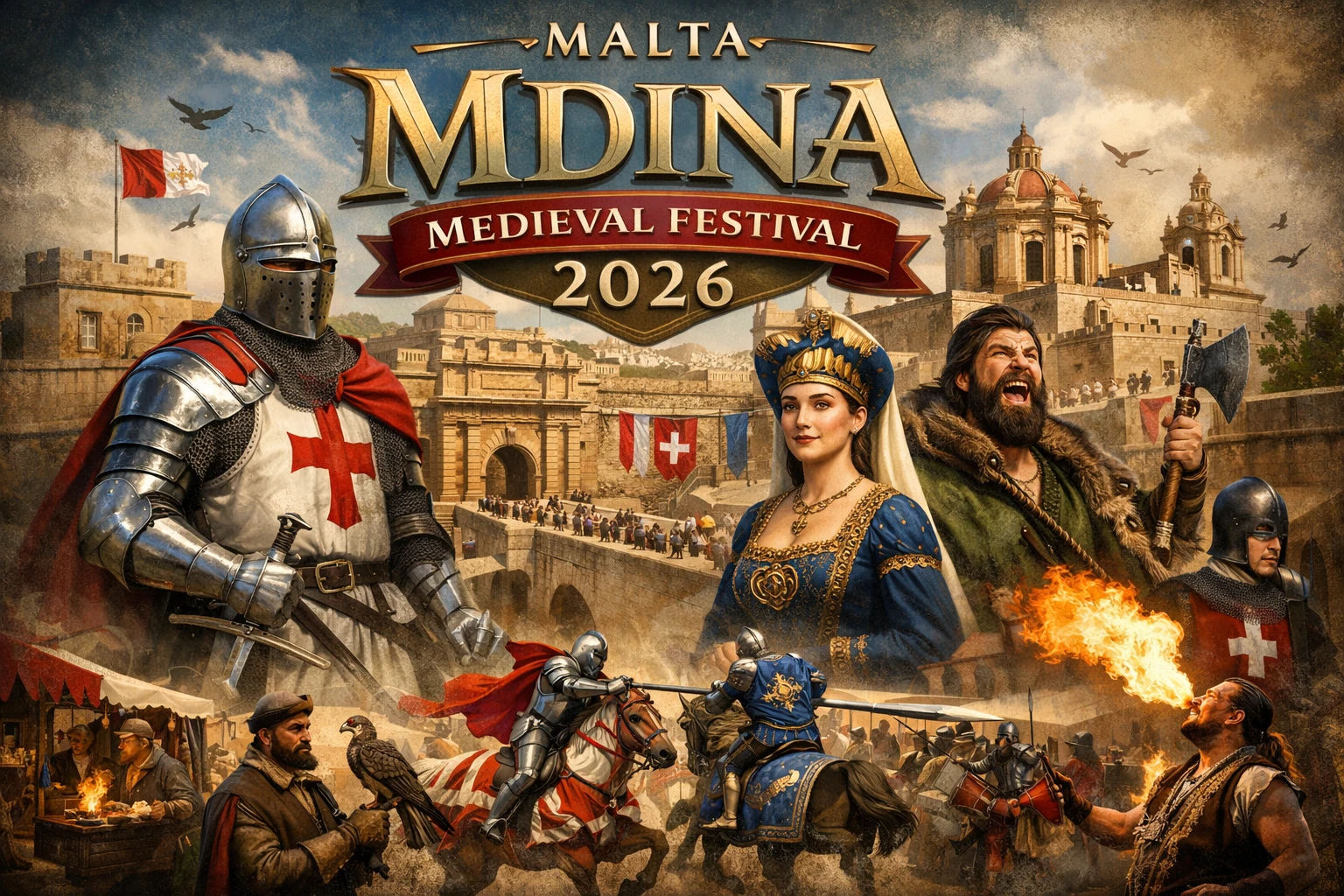
Update 4/29: This Event is Cancelled and is not scheduled for 2026
Mdina Medieval Festival Malta 2026: Step Back in Time Inside Europe's Most Extraordinary Walled City
There are festivals that recreate history in settings built to do exactly that: purpose-built theme parks, reconstructed village squares, open fields dressed with banners and hay bales. And then there is the Mdina Medieval Festival, which needs none of that, because the city that hosts it has been genuinely medieval for nearly a thousand years and has not changed very much since.
The Medieval Mdina Festival is an annual two-day celebration held in the streets, squares, and courtyards of Mdina, Malta's ancient walled hilltop capital, transforming the Silent City into a living recreation of life between 1200 and 1500 AD, with battle re-enactments, flag-throwing, falconry, jousting, medieval markets, archery, sword fighting, traditional food, jesters, musicians, and guided tours filling every corner of a city that was already old when the Knights of St John arrived in 1530.
The 2026 edition follows the festival's established annual tradition, typically held in late April or early May, and represents the 14th edition of an event that has grown from a local cultural initiative into one of the most visually spectacular and historically immersive festivals in the entire Mediterranean. Based on the consistent pattern of recent years, the 2026 dates are expected to fall on a late April or early May weekend, with the event running from 11:00 AM to 10:00 PM on the Saturday and 11:00 AM to 6:00 PM on the Sunday. Confirmed 2026 dates will be published on the Medieval Mdina Festival Facebook page and through the Mdina Local Council as the spring season approaches.
"This is one of the most genuinely extraordinary two-day events available anywhere in Europe, and it is completely free to attend."
Mdina: The City That Was Born Medieval
Understanding the Setting
You cannot properly appreciate the Mdina Medieval Festival without first understanding the city that hosts it, because the city is not simply a backdrop for the festival. It is the festival.
Mdina sits on a hilltop in the geographical centre of Malta, its limestone walls rising from a naturally defensive ridge that has made it a fortified settlement since at least 800 BCE, when the Phoenicians established the first permanent settlement here. The Romans called it Melite. The Arabs called it Mdina, giving it the name it carries today. The Normans, the Aragonese, the Knights of St John, the French, and the British all occupied it in turn, each leaving traces in the architecture, street layout, and accumulated culture of a city that has absorbed more history per square metre than almost any other place in the world.
Today, Mdina covers just half a square kilometre and is home to only approximately 300 permanent residents, making it one of the most sparsely populated cities in the world relative to its historical importance. Those residents live amid medieval and Baroque palaces, Norman architecture, narrow limestone streets barely wide enough for two people to pass, and the complete absence of motorised traffic within the ancient walls. The only sound on an ordinary day in Mdina is footsteps, birdsong, and occasionally the bells of the Metropolitan Cathedral of St Paul that has dominated the city's skyline since the 1690s.
"On Medieval Festival weekend, the Silent City erupts into the loudest, most colourful, most densely populated version of itself that it experiences all year."
The 2026 Festival Programme
A Full Medieval World
The Mdina Medieval Festival is organised by the Mdina Local Council with the involvement of local and international re-enactment groups who travel to Malta specifically for the event. The international dimension is one of the festival's most distinctive qualities: re-enactment societies from across Europe and beyond participate, bringing expertise, costumes, equipment, and performances that reflect medieval traditions from beyond Malta's own history, while Maltese groups contribute the local historical narrative.
The full programme of events across both festival days includes:
Battle Re-enactments: Spectacular staged battle scenes performed by international and local re-enactment groups, with full medieval armour, weaponry, and choreography recreating the combat traditions of the 1200 to 1500 AD period. These are the most visually dramatic element of the entire festival and draw the largest crowds of the day.
Falconry and Birds of Prey: Demonstrations by falconers with trained hawks, falcons, and eagles, showing the hunting and ceremonial traditions of medieval noble culture through live birds that are genuinely extraordinary to watch in the stone-walled streets of a medieval city.
Flag-Throwing (Sbandieratori): Performances by traditional Italian and Maltese flag-throwing groups, whose displays of aerial flag manipulation are rooted in the civic traditions of medieval Italian and Maltese city culture and provide some of the festival's most visually stunning street performances.
Sword Fighting and Archery: Live demonstrations of medieval combat techniques including sword fighting, archery competitions, and weapons handling by expert practitioners in full period costume.
Jousting Tournaments: Mock jousting in the spaces available within the walled city, recreating one of the most recognisable competitive traditions of medieval knightly culture.
Medieval Music: Live performances of medieval and Renaissance music throughout both days, using period instruments including lutes, rebecs, recorders, drums, and other historically appropriate instruments. The music fills Mdina's stone streets and provides the sonic environment that transforms the visual spectacle into a fully immersive sensory experience.
Jesters, Illusionists, and Street Performers: The lighter, more playful elements of the medieval entertainment programme, with jesters, illusionists, and street performers moving through the crowds throughout both days and ensuring that the festival's tone remains accessible, joyful, and inclusive alongside the more dramatic re-enactment elements.
Medieval Market: A market selling period-appropriate goods, crafts, clothing, and food in the style of a medieval trading fair, allowing visitors to browse and purchase directly from vendors in costume.
Medieval Kitchen and Tavern: Food and drink stalls serving medieval-inspired recipes and traditional Maltese fare in period-appropriate settings, including the medieval kitchen tradition that recreates the cooking methods and ingredients of 13th to 15th century Malta.
Slave Market Scenes: Historical re-enactments depicting one of the more uncomfortable but historically accurate aspects of medieval Maltese life, given the island's long experience of both Christian and Muslim slave trading in the Mediterranean world, presented within an educational context.
Lectures and Guided Tours: Academic and historical lectures delivered within the festival programme, alongside guided tours of Mdina's streets, palaces, and archaeological features that provide the historical context for what visitors are seeing in the re-enactments.
Children's Area: A dedicated space for younger visitors with age-appropriate medieval activities, crafts, and entertainment that makes the festival a genuine family event.
The festival runs from 11:00 AM to 10:00 PM on Saturday and 11:00 AM to 6:00 PM on Sunday, giving visitors a substantial programme window to explore both the events and the city itself.
Heritage Malta: Special Offers
Extended Hours and Reduced Entry
During the Mdina Medieval Festival weekend, Heritage Malta has consistently offered extended opening hours and significantly reduced ticket prices at key sites in and around Mdina, maximising the cultural value of the festival for visitors.
In previous editions, Heritage Malta offered:
Extended opening hours (9:00 AM to 6:00 PM, last admission 5:30 PM) at the National Museum of Natural History and the Domvs Romana (Roman townhouse museum) on both festival days.
A combined ticket at €2 (reduced from standard pricing) covering both sites during the festival period.
Guided tours of the Domvs Romana archaeological remains on the Saturday morning, limited capacity, bookable at Heritage Malta sites and online for approximately €10 for adults.
Worth Noting: These Heritage Malta special offers are expected to continue for the 2026 edition and represent an extraordinary additional value for cultural visitors attending the festival weekend.
The Cultural Significance
Medieval Malta's Living Memory
The Mdina Medieval Festival is not simply a historical theme park experience. It is a genuine act of cultural memory, organised by the Maltese community to acknowledge and celebrate a period of their island's history that is more complex, more violent, more cosmopolitan, and more interesting than any simplified narrative can capture.
Malta between 1200 and 1500 AD was at the crossroads of the medieval Mediterranean world. The island sat between the Christian kingdoms of Norman Sicily and Aragon to the north and the Islamic kingdoms of North Africa to the south. It was fought over, traded, taxed, and shaped by forces that had almost nothing in common with each other except the desire to control this strategically critical island.
"The festival recreates the period of 1200 to 1500 AD, which spans the Norman and Aragonese periods of Maltese history and covers the transformation of Mdina from the island's primary Arab-influenced settlement into the Gothic and Baroque city it became under the Knights."
Practical Information for 2026
Visiting Malta's Silent City
The festival is completely free to attend. There are no entrance fees and no tickets required for the public areas of the festival. Heritage Malta site entry is separately ticketed, with the special festival discount rates described above. The only costs a visitor incurs are what they choose to spend at food stalls, the medieval market, and any optional guided tours or site admissions.
Getting to Mdina:
By Bolt or taxi: The most convenient option from Valletta, Sliema, or St Julian's, with journey times of 15 to 25 minutes. Bolt operates island-wide.
By public bus: Malta's bus network connects Mdina with Valletta's main terminus via routes serving Rabat, the town immediately adjacent to Mdina's walls. The bus stops at Rabat's main square, from which Mdina's Main Gate is a 5-minute walk.
By car: Parking is available in Rabat adjacent to Mdina. The medieval festival weekend sees significantly higher than normal visitor numbers, so arriving early (before 11:30 AM on Saturday) is recommended to secure parking near the city gate.
Important logistics for the festival weekend:
Mdina's streets are extremely narrow and have no vehicle access. All movement within the festival is on foot. Comfortable walking shoes are essential.
The city's cobbled and stone-paved streets can be uneven. Visitors with mobility considerations should note that some areas within the festival are more accessible than others, though the main squares and wider streets are generally manageable.
The festival attracts large crowds, particularly on the Saturday from early afternoon onward. Arriving at opening time (11:00 AM) on either day gives the best experience with less crowd compression.
Water and snacks are available from stalls within the festival, but the queue at popular food points can grow later in the day.
Photography is permitted throughout the festival and the dramatic costumes, architecture, and performance settings make the Mdina Medieval Festival one of the most photographically rewarding events in Malta.
Nearby amenities:
The adjacent town of Rabat immediately outside Mdina's walls provides restaurants, cafes, and bars for pre and post-festival dining. The Fontanella Tea Garden within Mdina itself, situated on the city's bastion walls with panoramic views across Malta, is one of the island's most beloved lunch and coffee stops and is worth combining with the festival visit, though it will be busy during the festival weekend.
Exploring Mdina Beyond the Festival
The Silent City at Its Most Alive
For visitors coming to Malta specifically for the Medieval Mdina Festival, building a longer stay around the event gives access to everything the city and surrounding area has to offer outside the festival hours.
Within and adjacent to Mdina:
St Paul's Cathedral and Museum, the magnificent Baroque Metropolitan Cathedral that dominates the skyline, housing important paintings, silver, and historical artefacts.
Palazzo Falson Historic House Museum, a beautifully preserved Norman palace with collections of medieval and Renaissance objects that provide direct context for the festival's period.
National Museum of Natural History, housed in a Baroque palazzo within the city, covering Malta's natural history from its geological origins to its extraordinary endemic species.
Domvs Romana, in Rabat adjacent to Mdina, a Roman townhouse museum built around one of the finest mosaic floors surviving from Roman Malta, with Heritage Malta's festival discount making this a particularly valuable addition to the festival visit.
St Paul's Catacombs, early Christian burial catacombs in Rabat that predate the medieval period and add another layer to the archaeological richness of the area.
Frequently Asked Questions
When is the Mdina Medieval Festival 2026?
The Mdina Medieval Festival 2026 is expected to take place on a late April or early May weekend in 2026, consistent with the festival's established annual pattern. The 2025 edition took place on May 3 and 4. Confirmed 2026 dates will be published by the Mdina Local Council on the Medieval Mdina Festival Facebook page (facebook.com/MedievalMdinaFestival) and on Visit Malta.
Is the Mdina Medieval Festival free?
Yes. The Mdina Medieval Festival is completely free to attend. There are no entry tickets or fees for the public festival areas. Heritage Malta sites including the National Museum of Natural History and Domvs Romana offer special reduced combined entry during the festival weekend for approximately €2.
What is the Mdina Medieval Festival?
The Mdina Medieval Festival is an annual two-day event held in Mdina, Malta's ancient walled hilltop capital, recreating life between 1200 and 1500 AD through battle re-enactments, falconry, flag-throwing, jousting, archery, sword fighting, medieval music, jesters, a medieval market, medieval food and drink, guided tours, and children's activities. The 2026 edition will be the 14th in the festival's history.
How do I get to Mdina for the Medieval Festival?
Mdina is located in central Malta, approximately 12 kilometres from Valletta and 10 kilometres from St Julian's. It is reachable by Bolt ride-sharing (15 to 25 minutes from Valletta), public bus to Rabat (5-minute walk from Mdina's main gate), or by car with parking available in Rabat. All movement within the festival is on foot as Mdina has no vehicle access.
Is the Mdina Medieval Festival suitable for children and families?
Absolutely. The festival includes a dedicated children's area and is designed as a genuine family event. The combination of battle re-enactments, falconry, jesters, flag-throwing, and market stalls provides entertainment across all ages, and the medieval kitchen and food stalls add a sensory dimension that makes the experience memorable for younger visitors.
What edition is the Mdina Medieval Festival in 2026?
The 2026 edition will be the 14th annual festival. The 2025 edition (May 3 to 4, 2025) was the 13th.
An 800-year-old walled city. Jousting knights in the narrow stone streets. Falcons circling above medieval towers. Flag-throwers sending silk banners spinning into a blue Maltese sky. Battle re-enactments staged against architecture that was already old when the events they recreate were happening.
The Mdina Medieval Festival 2026 is entirely free, entirely extraordinary, and entirely unlike anything else available on any island in the Mediterranean. Check the Medieval Mdina Festival Facebook page for the confirmed 2026 weekend dates as they are announced, mark your Malta calendar accordingly, and make sure you are standing inside the walls of the Silent City when it becomes, for two days every spring, the loudest, most alive, most spectacularly medieval place in Europe.
Verified Information at a Glance
Event Name: Medieval Mdina Festival 2026
Organiser: Mdina Local Council
Event Category: Free Annual Historical Re-enactment and Cultural Festival
Edition: 14th Annual (2025 was the 13th edition)
2026 Expected Dates: Late April or early May 2026 weekend (exact dates to be confirmed by Mdina Local Council; 2025 edition was May 3 to 4)
Duration: 2 days
Daily Hours: Saturday 11:00 AM to 10:00 PM; Sunday 11:00 AM to 6:00 PM
Venue: Throughout the streets, squares, and courtyards of Mdina (the Silent City), Malta
Address: Mdina (Imdina), Malta
Historical Period Depicted: 1200 to 1500 AD (Norman and Aragonese Malta)
Admission: Completely free, no tickets required
Programme Highlights: Battle re-enactments, falconry, flag-throwing (sbandieratori), sword fighting, archery, jousting, medieval music, jesters, illusionists, medieval market, medieval kitchen, slave market scenes, lectures, guided tours, children's area
Heritage Malta Special Offers: Extended hours and €2 combined ticket for National Museum of Natural History and Domvs Romana during festival weekend (expected to continue for 2026)
Re-enactment Groups: Local Maltese and international groups
Suitable For: All ages, families welcome, children's area available
Nearest Town: Rabat (immediately adjacent to Mdina walls, 5-minute walk from main gate)
Getting There: Bolt/taxi from Valletta (15 to 25 minutes), public bus to Rabat, car with parking in Rabat
Confirmed Dates Source: Medieval Mdina Festival on Facebook (facebook.com/MedievalMdinaFestival) and Visit Malta (visitmalta.com)
Note: Specific 2026 dates were not yet publicly confirmed at the time of publication. Check the official sources listed above for the confirmed 2026 weekend announcement.