
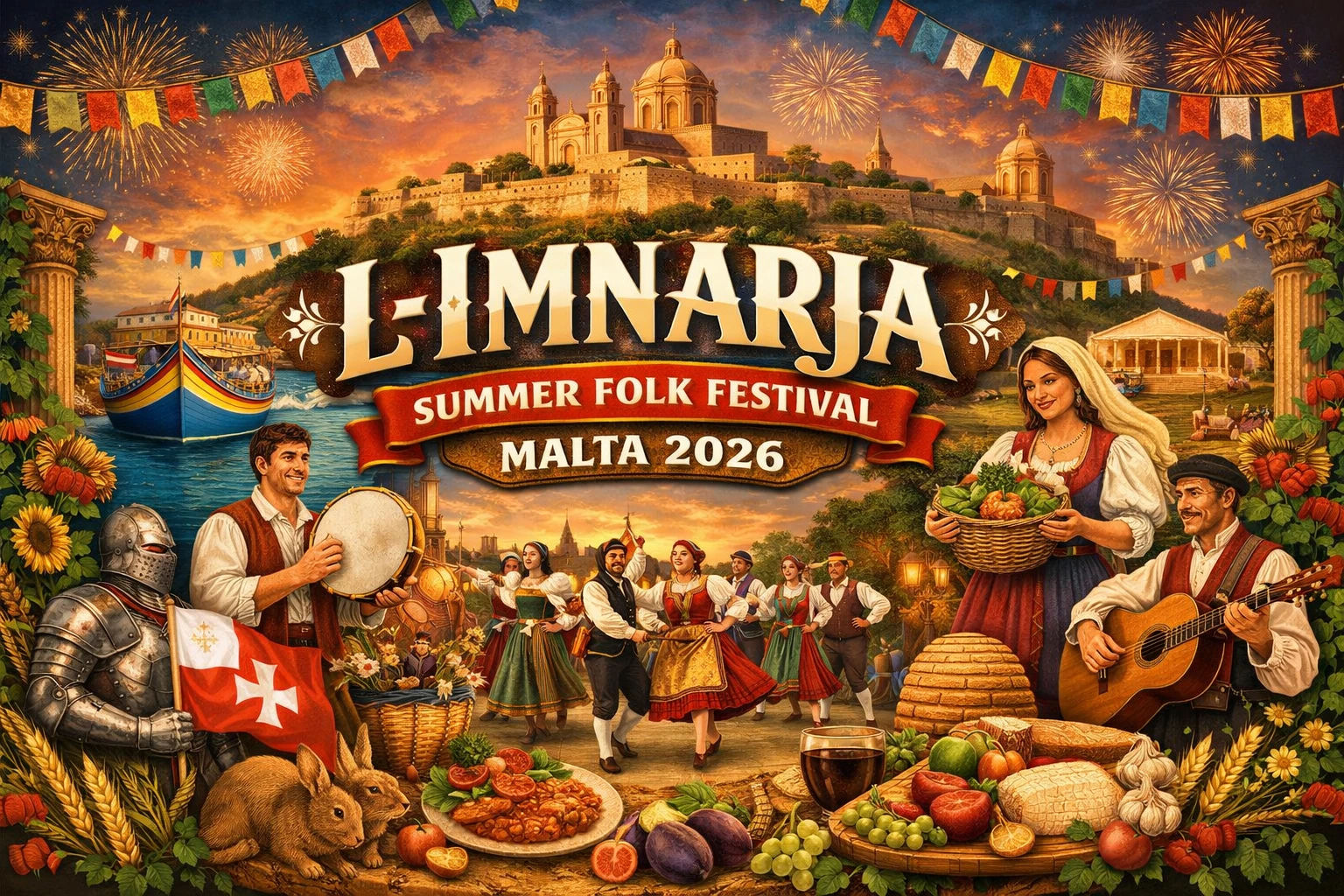
L-Imnarja Summer Folk Festival Malta 2026: The Ancient Feast of Light That Still Sets the Island Ablaze
Some festivals are new. Some are borrowed from elsewhere and given a local costume. And then there are those rare, irreplaceable celebrations that are so deeply woven into a people's identity that they have been going without interruption for centuries, outlasting empires, surviving colonisation, and remaining as vivid and alive in 2026 as they were when the Knights of St John first arrived on this island and found the Maltese already celebrating them.
L-Imnarja is that kind of festival. And in 2026, it falls on the nights of Sunday, June 28 and Monday, June 29, at the ancient woodland of Buskett Gardens in the heart of Malta, where it has been celebrated since before anyone currently alive was born, and where it will almost certainly be celebrated long after all of us are gone.
This is Malta at its most authentically itself. Folk music under the trees. Rabbit stew served from pots carried to the gardens by families who have been doing exactly this for generations. The traditional għana (Maltese folk singing) drifting across the night air. Children running between picnic blankets. Wine flowing freely. And above it all, the particular feeling that comes from being part of something genuinely ancient, genuinely rooted, and genuinely irreplaceable.
If there is one event on the Maltese calendar that rewards going simply to understand what Malta actually is beneath its summer festivals and beach parties and Instagram locations, it is L-Imnarja.
The History: A Festival Older Than Valletta Itself
Centuries of Continuous Celebration
The origins of L-Imnarja stretch back to the period before the arrival of the Knights Hospitaller in 1530, making it one of the oldest continuously celebrated festivals in the entire Mediterranean world. Its very name carries evidence of its ancient roots: "L-Imnarja" derives from the Italian and Latin word for "illuminaria" or festival of lights, a reference to the solstice bonfires that originally accompanied the celebration and that connected it to the deeply human tradition of marking the longest days of the year with fire and communal gathering.
The festival is formally tied to the Feast of Saints Peter and Paul, celebrated on June 29 in the Catholic calendar, which the Maltese Church adopted as the official liturgical anchor for what was already an existing popular celebration. This layering of ancient pagan solstice traditions onto a Catholic saints' feast is entirely characteristic of how Mediterranean folk culture works: the Church gave the celebration a new name, but the people kept the bonfire.
Over the centuries that followed, L-Imnarja evolved into the celebration it is today. The Agrarian Society of Malta became one of its principal organising bodies, introducing the tradition of agricultural exhibitions, livestock competitions, and prize-giving that still forms a core part of the multi-day programme. The picnic tradition in Buskett Gardens became so deeply embedded in Maltese culture that even during the difficult years of the 20th century, families continued arriving on the eve of June 29 to spend the night under the trees, as their grandparents had done before them.
"L-Imnarja is a celebration that connects every family around a pot that has been simmering in the same way for generations."
Buskett Gardens: The Only Forest in Malta
Why This Particular Place Matters
Buskett (from the Italian "boschetto," meaning small wood) is the only significant area of woodland on the entire island of Malta, a fact that makes it uniquely precious in a landscape otherwise characterised by limestone terraces, open fields, and Mediterranean scrub. The gardens were originally planted as a hunting reserve by the Knights of St John in the 16th century, with the intention of providing a cool green retreat from the heat of the Maltese summer.
The gardens sit in a natural valley in the Rabat-Dingli area of central-western Malta, approximately 10 kilometres southwest of Valletta. The valley creates a microclimate noticeably cooler and more humid than the surrounding limestone plateau, and the combination of mature trees, running water, and natural shade makes it a genuinely different sensory experience from anywhere else on the island.
On the night of L-Imnarja, Buskett transforms completely. The gardens that are peacefully empty on most days of the year fill with thousands of Maltese families who have been coming here every June 28 and 29 for as long as their family can remember. The sound of the forest is replaced by the sound of hundreds of conversations, folk music performances, and the particular acoustic blend of a Maltese summer night with thousands of people in a woodland valley.
The Full L-Imnarja 2026 Programme: Week of Celebrations
More Than Just Two Nights in Buskett
The 2026 L-Imnarja celebrations are not limited to the June 28 and 29 events at Buskett. A full programme of events builds across the week leading up to the main feast, reflecting the depth and seriousness with which Malta treats this annual celebration.
The multi-day programme includes:
A parade in Rabat on the Saturday before the feast, led by the Agrarian Society of Malta, which brings together agricultural exhibitors, traditional dress, and the formal opening of the week's ceremonies.
Agricultural and livestock exhibitions throughout the week, where Maltese farmers bring their finest animals and produce for judging and display, continuing the tradition of L-Imnarja as an agricultural festival that celebrates the island's farming heritage.
The karrettuni and karozzini parade on June 28, one of the most visually distinctive elements of the entire festival. Traditional Maltese horse-drawn carts and carriages process from Saqqajja Hill in Rabat to Buskett Gardens, decorated with colourful trappings and accompanied by their owners in traditional dress.
Agricultural machinery exhibitions at Buskett on June 28, displaying the history of farming tools and techniques that have shaped the Maltese countryside.
Traditional games on the evening of June 28, reviving competitive pastimes that date back centuries in Maltese folk culture.
Traditional music, dancing, and Maltese għana throughout the evening of June 28 and the morning of June 29, the central performance element of the entire festival.
The Food: Fenkata, the Rabbit Feast
The Most Important Meal in the Maltese Tradition of L-Imnarja
If you need to understand what L-Imnarja means to Maltese people through a single object, it is the rabbit dish. Rabbit, known in Maltese as fenek, is the national dish of Malta, and its preparation and consumption at L-Imnarja is not simply a food choice. It is a ritual, a tradition, and a form of cultural continuity that connects every family around a pot that has been simmering in the same way in Buskett Gardens on this same night for as long as anyone can trace.
The traditional fenkata served at L-Imnarja is typically prepared as:
Spaghetti bl-aljotta tal-fenek (pasta with rabbit sauce), the first course.
Fenek moqli or fenek fuq in-nar (fried or slow-cooked rabbit), the main course.
Served with local bread, fresh salad, and the inevitable bottles of Maltese wine and Kinnie (the island's beloved bittersweet soft drink made from bitter oranges and aromatic herbs).
Families bring entire meals prepared at home, spreading picnic blankets under the trees and making Buskett Gardens into the largest, most communal open-air dining experience on the island. Local restaurants and food stalls also set up within and around the gardens for those who prefer to eat on site.
The smell of rabbit cooking over fires and the sound of family conversations in Maltese across hundreds of picnic blankets is, in the most fundamental way possible, what L-Imnarja actually is.
The Music: Għana Under the Stars
Malta's Most Ancient Folk Song Tradition
At the heart of the L-Imnarja musical programme is għana (pronounced "ah-na"), the traditional Maltese folk singing tradition that is one of the most distinctive and least-known musical forms in the entire Mediterranean.
Għana is a form of spontaneous improvised singing, typically performed by two or more singers who engage in a battle of wits, trading verses on a chosen topic in a competitive and sometimes comedically sharp call-and-response format called spirtu pront. The melodic structure of għana shows clear Arabic influence, a musical legacy of the Arab period of Maltese history from the 9th to 11th centuries, and the improvisational element requires the singers to be quick-witted poets as much as musicians.
At L-Imnarja, the għana performers are the most anticipated cultural figures of the entire festival. Their performances attract devoted crowds of listeners who understand the tradition deeply, respond to every verse with laughter, applause, or competitive appreciation, and treat the best performances with a reverence that no other form of Maltese cultural expression quite generates.
The town of Żejtun in southern Malta is particularly celebrated as the birthplace of the greatest għana singers in Maltese history, and the Żejtun connection to L-Imnarja runs through the music programme every year. Birżebbuġa on the southern coast is similarly regarded as a stronghold of the tradition, and the best għannejja (folk singers) from these communities form the core of the musical programme.
The 2026 Context: L-Imnarja Within Malta's Folk Music Year
The Ritmu Roots Festival: The Perfect Prelude
The L-Imnarja celebrations in 2026 are preceded by the Ritmu Roots Festival from May 20 to 23, curated by musical director Andrew Alamango, which brings together Mediterranean folk artists alongside Maltese għana singers in concerts, workshops, and exhibitions across Malta.
The Ritmu Roots Festival effectively primes the cultural environment of the island for L-Imnarja, creating a June in which traditional Maltese and Mediterranean folk music is more visible, more accessible, and more discussed than at any other time of year. For visitors arriving specifically for L-Imnarja, attending Ritmu Roots first provides invaluable context for what they will experience in Buskett Gardens on June 28 and 29.
The FestGħana programme, focused specifically on traditional Maltese folk song, also runs in May 2026, providing dedicated concerts and events that celebrate the għana tradition in the weeks before it reaches its most natural and unrepeatable setting at L-Imnarja.
Practical Information for Visitors
How to Experience L-Imnarja 2026 Like a Local
L-Imnarja is completely free to attend. There are no tickets, no entrance fees, and no reserved areas. The gates of Buskett Gardens are open to everyone, as they have been every June 28 and 29 for centuries. What you spend is only what you choose to eat and drink, whether from the stalls within the gardens or from a homemade picnic you have prepared and carried in yourself.
Practical preparation for visiting L-Imnarja 2026:
Arrive on the evening of June 28 rather than June 29. The night of the 28th is when the festival is at its most alive, with the karrettuni parade arriving, the music running through the night, and the families who have kept this tradition settling in for a night of food, conversation, and folk song.
Bring a picnic blanket and your own food if possible. This is how Maltese families experience L-Imnarja, and doing the same immediately connects you to the tradition rather than keeping you at arm's length from it as a visitor.
Try the fenkata. Whether from a local restaurant in Buskett or from a neighbouring family who offers you a taste, eating rabbit in Buskett on this specific night is not optional. It is the point.
Stay for the għana. The performances typically begin in the evening and continue late into the night. Positions close to the main stage fill early.
Wear comfortable shoes for walking through the gardens on potentially uneven ground, and bring a light layer for the late-night hours when the temperature in the wooded valley can drop compared to the surrounding plateau.
Arrive by car or Bolt. Buskett Gardens is approximately 10 kilometres from Valletta. Bolt ride-sharing operates island-wide, and parking is available in the surrounding area though it fills quickly on L-Imnarja nights.
Frequently Asked Questions
When is L-Imnarja 2026 in Malta?
L-Imnarja 2026 takes place on the nights of Sunday, June 28 and Monday, June 29, 2026, at Buskett Gardens, Rabat, Malta. The main programme of music, dancing, and traditional celebrations runs overnight from the evening of June 28 into the morning of June 29, which is the official feast day of Saints Peter and Paul.
Is L-Imnarja free to attend?
Yes. L-Imnarja is completely free of charge. There are no entry tickets and no reserved areas. The celebrations at Buskett Gardens are open to everyone. Food, drinks, and stalls within the gardens are available at normal commercial prices, and many families bring their own picnics.
Where exactly is Buskett Gardens in Malta?
Buskett Gardens is located in the Rabat area of west-central Malta, approximately 10 kilometres southwest of Valletta. The gardens sit in a natural valley and form the only significant woodland on the island. They are accessible by car, Bolt ride-sharing, or public bus from Valletta and other towns.
What is the traditional food eaten at L-Imnarja?
The traditional food of L-Imnarja is rabbit, known in Maltese as fenek, typically served as pasta with rabbit sauce followed by fried or slow-cooked rabbit. This tradition of rabbit-eating at the festival is central to Maltese cultural identity and has been part of L-Imnarja for generations.
What is għana music and why is it important at L-Imnarja?
Għana is the traditional improvised folk singing of Malta, performed in a competitive call-and-response format by singers known as għannejja. It shows clear Arabic melodic influence from Malta's medieval history and requires singers to improvise verses spontaneously in what is called spirtu pront. Għana is the most cherished musical element of L-Imnarja, with the best performers drawing dedicated crowds who follow every verse closely.
How long has L-Imnarja been celebrated in Malta?
L-Imnarja predates the arrival of the Knights of St John in 1530, making it a tradition of at least 500 years and almost certainly considerably older, with origins in ancient solstice celebrations. It is one of the oldest continuously celebrated folk festivals in the entire Mediterranean world.
The lights of Buskett Gardens on a June night, the sound of għana rising through the trees, the smell of rabbit cooking over open fires, and the knowledge that the family next to yours has been doing exactly this for longer than any living person can remember.
L-Imnarja 2026 runs on June 28 and 29 at Buskett Gardens, and it is free, it is ancient, it is alive, and it is the single most genuinely Maltese thing you can experience on this island. However many other events fill your Malta summer itinerary, clear the night of June 28 and show up at Buskett. The tradition is waiting.
Verified Information at a Glance
Event Name: L-Imnarja Summer Folk Festival 2026
Also Known As: Feast of St. Peter and St. Paul (L-Imnarja), Festival of Light
Event Category: Free Annual Traditional Folk Festival and Agricultural Celebration
Historical Origins: Pre-1530, predating the Knights of St John (over 500 years of continuous celebration)
2026 Dates: Sunday, June 28 and Monday, June 29, 2026
Venue: Buskett Gardens (Bosk), Rabat area, Malta
Admission: Completely free, no tickets required
Programme Highlights: Karrettuni and karozzini parade (June 28), agricultural exhibitions, traditional games, Maltese għana folk singing, traditional music and dancing, fenkata (rabbit feast)
Parade Route: Saqqajja Hill, Rabat to Buskett Gardens (June 28)
Organiser: Agrarian Society of Malta, supported by Festivals Malta and community organisations
Traditional Food: Fenek (rabbit), pasta bl-aljotta tal-fenek, local wine and Kinnie
Folk Music Tradition: Għana (traditional improvised Maltese folk singing)
Related 2026 Events: Ritmu Roots Festival (May 20 to 23, Ta' Qali), FestGħana (May 2026)
Location: Buskett Gardens, approximately 10km southwest of Valletta, Rabat area, Malta
Transport: Bolt ride-sharing, car; parking available in surrounding area
Official Tourism Listing: visitmalta.com
Suitable For: All ages; families, cultural visitors, folk music enthusiasts, food lovers