
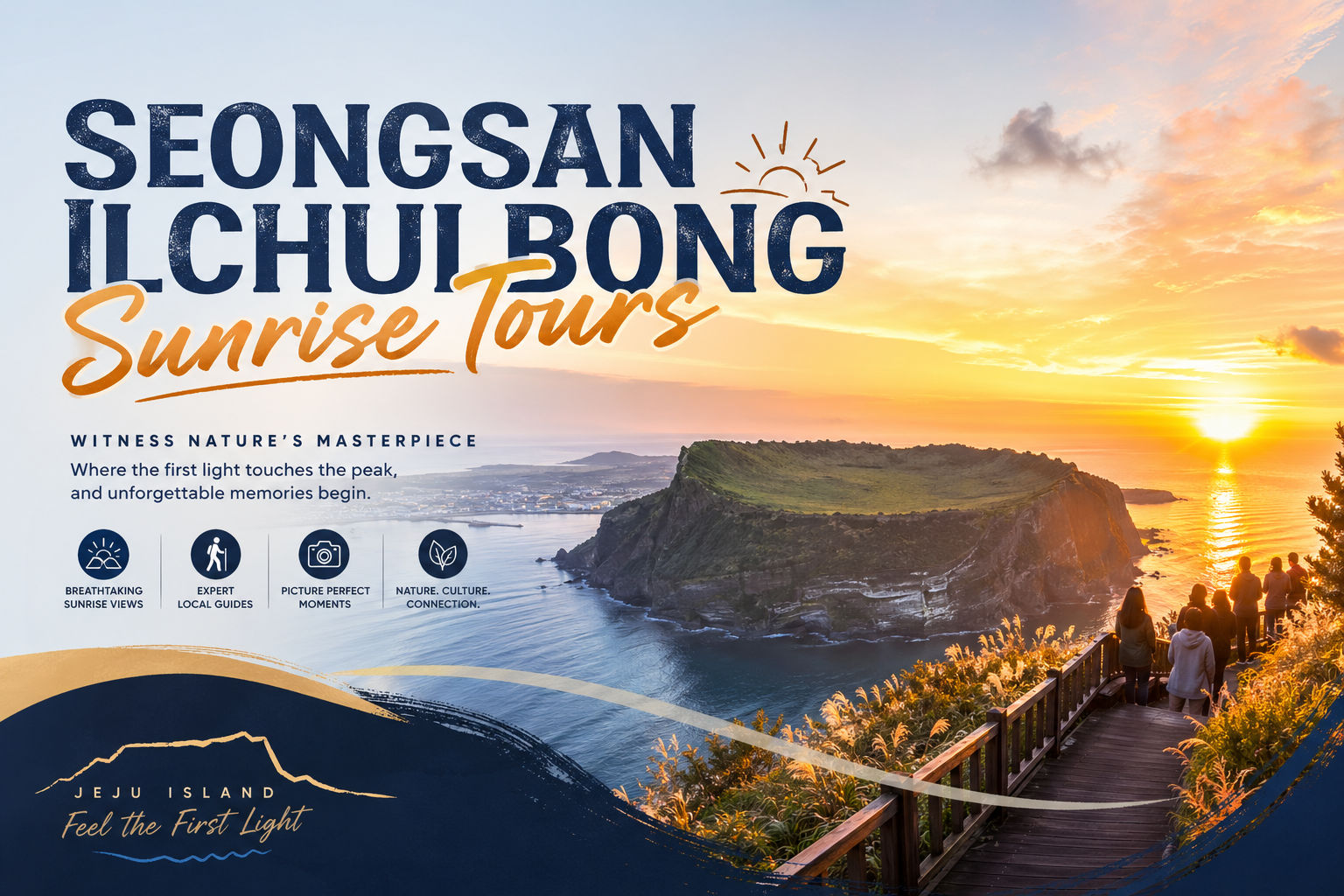
Seongsan Ilchulbong Sunrise 2026 — Watching the Sun Rise from a 5,000-Year-Old Volcanic Crater
There are places in the world where a single experience justifies an entire journey. Seongsan Ilchulbong — Sunrise Peak — is that kind of place. A 5,000-year-old volcanic tuff cone rising from the sea at the eastern tip of Jeju Island, it is named for the thing it does best: frame the sun as it rises over the Pacific horizon, viewed from inside the rim of an ancient crater 180 metres above the sea.
It is a UNESCO World Natural Heritage Site, one of the most visited natural landmarks in South Korea, and the experience of climbing to the summit in the pre-dawn dark — arriving to claim a spot on the wooden boardwalk seats at the crater rim as the sky transitions from black to deep blue to the first orange and pink of sunrise — is one that stays with visitors permanently.
"The view is worth every step."
Admission is 5,000 KRW (~$3.70 USD). During sunrise hours, entry is free. The climb takes 15 to 30 minutes.
Volcanic Majesty
A Tuff Cone on Jeju's Edge
Seongsan Ilchulbong (성산일출봉) is a volcanic tuff cone — a type of volcanic crater formed when magma erupts through shallow ocean water, producing an explosive steam-driven eruption that builds a steep-sided cone of compacted ash and volcanic debris rather than flowing lava.
The eruption that built Seongsan Ilchulbong happened approximately 5,000 years ago — geologically recent, and part of the same volcanic activity that has shaped Jeju Island's entire landscape, including Hallasan's most recent eruptions and the lava tube systems of the island's interior.
- The cone rises 180 metres (590 feet) directly from the sea — connected to the main body of Jeju Island by a narrow coastal isthmus, giving it the appearance from the sea of a fortress or citadel rising from the water.
- The crater at the summit is approximately 600 metres in diameter — a vast bowl of green grass and volcanic rock sitting at the top of the cone, surrounded by the crater rim.
- The eastern face of the cone drops vertically as sheer coastal cliffs directly into the sea — creating the dramatic frame from which the sunrise appears on the eastern horizon.
- The summit crater rim is accessible via the hiking trail, and a wooden boardwalk with seating runs along the rim specifically for sunrise viewing.
UNESCO inscription: Part of the Jeju Volcanic Island and Lava Tubes World Natural Heritage Site, inscribed 2007 — recognised as one of Earth's finest examples of volcanic landscape evolution and geological diversity.
The Sunrise Experience
From Darkness to Dawn
The sunrise at Seongsan Ilchulbong is not just a pretty view. It is a sequence — a physical progression through darkness, cold wind, climbing effort, and the specific stillness that arrives when hundreds of people simultaneously stop talking and watch the same thing happen.
"The moment the full disc of the sun appears is when the silence breaks and the collective exhale and exclamation from the crowd happens simultaneously."
The step-by-step sunrise experience:
Arrival (1-2 hours before sunrise):
Park at the free parking area adjacent to the trailhead. The approach road and parking area are quiet in the dark — the atmosphere is already different from a standard tourist visit. Other early arrivals are moving with the same purposeful quiet toward the gate. In summer this means arriving around 4:30-5:00 AM; in spring around 5:00-5:15 AM; in autumn around 5:00-5:15 AM; in winter around 6:00-6:30 AM.
The approach (15 minutes on flat ground):
A gradual, well-paved sloping path leads from the gate to the base of the cone — approximately 15 minutes at an easy walking pace. The path is lit, flat, and entirely accessible. The volcanic rock walls and the shapes of the crater against the night sky become visible as the path rises toward the main climb.
The climb (15-30 minutes of stairs):
The gradual path transitions to stairs — wide, well-maintained stone and concrete steps that ascend the steep face of the cone to the crater rim. For fit walkers this takes approximately 15-20 minutes. At an unhurried pace, allowing for pauses and the pre-dawn atmosphere, more like 25-35 minutes. The stairs are not technically difficult — there are no scrambling sections or exposed ridges — but they are steep enough that arriving with 40-50 minutes to spare before sunrise is the minimum recommended window.
The summit — crater rim and boardwalk:
The summit arrives suddenly — the stairs end and the full panorama opens. The crater bowl behind you, the ocean ahead, and the eastern horizon stretching from the cliffs below to the far sea. A wooden boardwalk with seating runs along the crater rim specifically designed for sunrise watching — take a seat, get your breath back, and wait.
The sunrise:
The sky begins to change on the eastern horizon — deep blue giving way to indigo, then the first suggestion of orange at the very edge of the sea. As the colour builds, the cliffs below glow, the ocean surface catches the light, and then — often quite suddenly — the sun clears the horizon.
The descent (20-30 minutes):
The descending path is described as continuing to be beautiful — the views back toward Seongsan town, Udo Island, and the broad eastern coast of Jeju from the descent path are themselves extraordinary, often better lit than the pre-dawn ascent. The path continues around the other side of the cone back to the base.
Sunrise Times by Season
When to Set Your Alarm
The correct alarm time for a Seongsan Ilchulbong sunrise depends entirely on which month you are visiting. The arrival recommendation is 40-50 minutes before sunrise at minimum; 1-2 hours before for the most comfortable positioning and crowd management, especially in peak travel season.
Monthly sunrise times at Seongsan Ilchulbong, 2026:
- January: ~7:30 AM; Recommended Arrival: 6:30-7:00 AM
- February: ~7:00 AM; Recommended Arrival: 6:00-6:30 AM
- March: ~6:30 AM; Recommended Arrival: 5:30-6:00 AM
- April: ~6:00 AM; Recommended Arrival: 5:00-5:30 AM
- May: ~5:40 AM; Recommended Arrival: 4:45-5:00 AM
- June: ~5:20-5:30 AM; Recommended Arrival: 4:30-4:45 AM
- July: ~5:20 AM; Recommended Arrival: 4:30-4:45 AM
- August: ~5:35-5:40 AM; Recommended Arrival: 4:45-5:00 AM
- September: ~6:00 AM; Recommended Arrival: 5:00-5:15 AM
- October: ~6:15 AM; Recommended Arrival: 5:15-5:30 AM
- November: ~6:45 AM; Recommended Arrival: 5:45-6:00 AM
- December: ~7:20 AM; Recommended Arrival: 6:20-6:45 AM
Check the exact sunrise time for your specific date at sunrise-sunset.org or the Korean Meteorological Administration (kma.go.kr) — times shift by 1-3 minutes per day through the peak seasons.
Park Hours & Admission
Key Details for 2026
Park opening hours:
- Summer (June-August): Opens from 5:00 AM / closes 7:00 PM
- Spring and Autumn: Regular daytime hours from 7:00-7:30 AM / closes 7:00 PM
- Winter (November-February): Opens 7:30 AM / closes 6:00 PM
- Special sunrise access: The gate opens before regular park hours during the sunrise window — access is available to allow visitors to climb for sunrise viewing. Entry during this pre-opening sunrise window is free
Admission:
- Adults: 5,000 KRW (~$3.70 USD)
- Children under 6: Free
- During sunrise window (before regular opening): Free
Parking: Free at the trailhead parking area
Monthly closure: One day per month for trail maintenance — check the official Jeju National Park website before your visit to avoid arriving on a closure day
Address: 284-12 Ilchul-ro, Seongsan-eup, Seogwipo-si, Jeju-do
The haenyeo show (if adding to a morning visit): daily at 1:30 PM and 3:00 PM at the Sea Women Restaurant area near the base of Seongsan Ilchulbong — approximately 2 USD additional admission
Best Seasons for the Hike
Spring & Autumn Shine
Spring — April to May (Recommended):
Spring is the most consistently praised season for Seongsan Ilchulbong sunrise visits. Mild temperatures (12-20°C at the summit in the early morning), clear air with low humidity, and the bonus of wildflowers and fresh green vegetation on the crater rim and approach path. Sunrise at approximately 5:40-6:00 AM means a 4:45-5:15 AM arrival — a reasonable alarm time that doesn't require a 3:00 AM start. Clear skies are more reliable in spring than in the summer rainy season. Fewer crowds than the summer peak.
Autumn — September to November (Recommended):
The second peak season and consistently the least crowded of the prime viewing windows. Crisp clear air following the summer heat, the island's foliage beginning to turn in October-November, and sunrise at a comfortable 6:00-6:45 AM range. The combination of clear skies, cool temperatures, and the visual drama of autumn's late golden light on the volcanic crater makes October and November arguably the most beautiful months on the calendar for both the sunrise and the descent view.
Summer — June to August:
The earliest sunrise window (5:20-5:40 AM) means a 4:30 AM arrival — not unreasonable, but the earliest alarm of any season. Summer brings the highest crowds, heat and humidity building quickly after sunrise, and the jangma rainy season from mid-June to mid-July bringing frequent cloud that can obscure the horizon. That said, a clear summer sunrise at Seongsan — the sea lit in pink and gold, the humidity giving the air a soft haze, hydrangeas beginning to bloom on the lower approach — is extraordinary in its own way. Worth attempting; manage expectations around weather.
Winter — November to February:
Winter brings the latest sunrise (~7:00-7:30 AM) and the most dramatic cloud and mist conditions — but also some of the clearest winter mornings that Jeju produces, when the air is cold and sharp and the visibility extends for extraordinary distances. January 1 is the single most attended sunrise date at Seongsan Ilchulbong of the entire year — thousands of visitors make the pilgrimage for the first sunrise, creating a collective atmosphere unlike any other date on the calendar.
Eastern Jeju Adventure
One-Day Route Highlights
Seongsan Ilchulbong anchors the eastern end of Jeju's most rewarding single-day route. Starting with sunrise at Seongsan and continuing east and west through the day covers the finest collection of natural and cultural landmarks on the island.
Recommended Eastern Jeju Day Route:
- 4:30-5:00 AM: Arrive at Seongsan Ilchulbong
- 5:20-6:00 AM: Sunrise at the crater rim (season-dependent)
- 7:00-8:00 AM: Descend; breakfast at one of the cafés and restaurants in Seongsan town (haenyeo caught seafood, juk rice porridge, local black sesame or tangerine menus)
- 9:00-11:00 AM: Seopjikoji — the volcanic cape immediately south of Seongsan with dramatic black lava rock coastline, blue church (Seopjikoji Cathedral), sea stacks, and views back toward the cone of Ilchulbong; famous as a Korean drama filming location
- 11:00 AM-1:00 PM: Udo Island ferry from Seongsan Pier (15 minutes, regular service); Udo is a small, flat island with peanut-based street food, turquoise coves, coral beaches, and bicycle or scooter rental for the perfect 2-hour loop
- 2:00-3:00 PM: Return ferry from Udo; daily haenyeo show at Seongsan at 1:30 PM or 3:00 PM if returning earlier (approximately 2 USD admission)
- 3:30-5:00 PM: Seongeup Folk Village inland from Seongsan — one of the best-preserved traditional Jeju stone-wall village communities, with actual inhabited houses, thatched roofs, and the distinctive volcanic basalt Dolharubang grandfather stone statues
- 5:30-7:00 PM: Woljeongri Beach or Hamdeok Beach on the north coast — sunset at either of these east coast beaches as the last light of the day catches the water
- Evening: Return to Jeju City or a Seongsan base for dinner
Guided tour options for the eastern route:
- KoTourLive Eastern Jeju tour: kotourlive.com — guided small group with Seongsan, Seopjikoji, and Seongeup Folk Village
- Viator Seongsan Ilchulbong tours: Multiple options including cruise ship-specific tours departing from Jeju Port, covering Seongsan, Seopjikoji, Seongeup Folk Village, and Dongmun Market
- GetYourGuide East Jeju Hydrangea Festival Tour (June-July): Adds hydrangea viewing to the standard east route for the June-July season
- Private car tours: Available widely through local Jeju tour operators; the east route is the most popular private car tour on the island
Practical Information
Getting There & Essentials
Getting to Seongsan Ilchulbong from Jeju City:
- By car or taxi: Approximately 50-60 minutes from Jeju City and Jeju International Airport via the Jeju Expressway east — the most practical option for an early morning sunrise arrival. Kakao T (Korean ride-hailing) or a rental car; taxis are available but must be pre-booked for 4:00-5:00 AM departures from Jeju City
- By intercity bus: From Jeju City intercity bus terminal to Seongsan — approximately 60-75 minutes; first buses of the day may not reach Seongsan early enough for a summer sunrise; check schedules for your visit dates
- From Seogwipo City: Approximately 40-50 minutes by car on the coastal road east
- Parking: Free at the site; arrive early for summer and peak season dates as the lot fills by 5:00 AM on busy days
What to wear for a sunrise hike:
- Comfortable walking shoes or light hiking shoes — the stairs are concrete and stone, not technical terrain, but good grip helps
- Warm layers for the summit — even in summer, the crater rim at pre-dawn has a significant wind chill. Spring and autumn mornings require a fleece or insulated layer; winter requires a proper warm jacket, gloves, and hat
- Light rain jacket (April-July especially — Jeju's early morning coastal weather can shift quickly)
- Headlamp or phone torch for the very early pre-dawn arrivals in summer (4:30 AM is still fully dark)
What to bring:
- Water (the climb is moderate but continuous; dehydration in summer is real)
- Camera — a wide-angle or standard lens handles both the panoramic horizon shot and the crater bowl; the blue-hour light before sunrise produces extraordinary colour even before the sun appears
- Cash for the admission fee (5,000 KRW; some visitors report mobile payment acceptance at the ticket booth but cash is reliable)
- Arrive 40-50 minutes minimum before sunrise; 1-2 hours before for peak season dates
Frequently Asked Questions
What are the Seongsan Ilchulbong opening hours for sunrise in 2026?
For sunrise viewing, Seongsan Ilchulbong's gates open before the regular park opening hours to allow climbers to reach the summit in time. In summer (June-August) this means gate access from approximately 5:00 AM (or earlier); in winter from approximately 7:00-7:30 AM. Entry during the pre-regular-opening sunrise window is free. Regular daytime admission is 5,000 KRW (~$3.70 USD). Parking is free. The park closes at 7:00 PM (summer) and 6:00 PM (winter). Note one maintenance closure day per month — check before visiting.
What time does the sun rise at Seongsan Ilchulbong in 2026?
Sunrise times vary significantly by season: June-July (earliest, ~5:20-5:30 AM); August (~5:35-5:40 AM); April-May and September (~5:40-6:00 AM); March and October (~6:15-6:30 AM); November-February (~6:45-7:30 AM). Arrive at least 40-50 minutes before sunrise and ideally 1-2 hours before in peak travel season. Verify your exact date's sunrise time at a sunrise calculator before your visit.
How long does it take to climb Seongsan Ilchulbong?
The full walk from the gate to the summit crater rim takes approximately 30-45 minutes total — about 15 minutes of flat approach path, then 15-20 minutes of stairs for fit walkers, or 25-35 minutes at a relaxed pace. The stairs are steep but not technically difficult. The descent takes a similar amount of time via the return path on the opposite side of the cone. The entire visit including summit time is typically 1.5 to 2.5 hours.
Is Seongsan Ilchulbong worth visiting if the sunrise is cloudy?
Yes. The crater rim view, the ocean cliffs, the volcanic landscape, and the scale of the crater bowl are worth the climb regardless of sunrise conditions. A cloudy morning still produces dramatic light — the diffused colour across the sea on an overcast sunrise can be more atmospheric than a clear-sky view. The descent path views across eastern Jeju and toward Udo Island are themselves excellent. And the haenyeo diving show at 1:30 PM and 3:00 PM near the base is a completely separate and worthwhile experience accessible on the same visit.
What is the best time of year to visit Seongsan Ilchulbong?
April-May (spring) and October-November (autumn) are the most consistently recommended seasons — clear skies, mild temperatures, manageable crowds, and the best conditions for both the sunrise and the overall hiking experience. Spring adds wildflowers and fresh green vegetation; autumn adds cool crisp air and the early stages of fall foliage. For the most dramatic single-day experience, January 1 (New Year's sunrise) draws the largest crowd of the year but delivers a collective atmosphere that is unique.
Verified Information at a Glance
- Name: Seongsan Ilchulbong (성산일출봉) — "Sunrise Peak"
- Type: Volcanic tuff cone, 5,000 years old
- Elevation: 180 metres (590 feet)
- Crater diameter: ~600 metres
- UNESCO status: World Natural Heritage Site (Jeju Volcanic Island and Lava Tubes, 2007)
- Address: 284-12 Ilchul-ro, Seongsan-eup, Seogwipo-si, Jeju-do
- Admission: 5,000 KRW (~$3.70 USD); free under 6; free during sunrise window
- Parking: Free
- Hours: Summer 5:00 AM–7:00 PM; Winter 7:30 AM–6:00 PM; sunrise window opens earlier
- Monthly closure: One maintenance day per month — verify before visiting
- Climb time: 30-45 min total from gate to summit; 15-20 min stairs
- Summit feature: Crater rim; wooden boardwalk seating; panoramic ocean views
- Arrive before sunrise: 40-50 min minimum; 1-2 hours recommended peak season
- Sunrise times: Summer (Jun-Aug) ~5:20-5:40 AM; Spring/Autumn ~6:00 AM; Winter ~7:00-7:30 AM
- Best seasons: April-May and October-November
- Special date: January 1 — largest annual gathering
- Haenyeo show: 1:30 PM and 3:00 PM daily, near the base (~2 USD)
- Nearby: Seopjikoji cape; Udo Island (ferry 15 min); Seongeup Folk Village; Woljeongri Beach; Hamdeok Beach
- Getting there: ~50-60 min from Jeju City by car; ~40-50 min from Seogwipo
- Guided tours: KoTourLive, Viator, GetYourGuide — east Jeju routes