
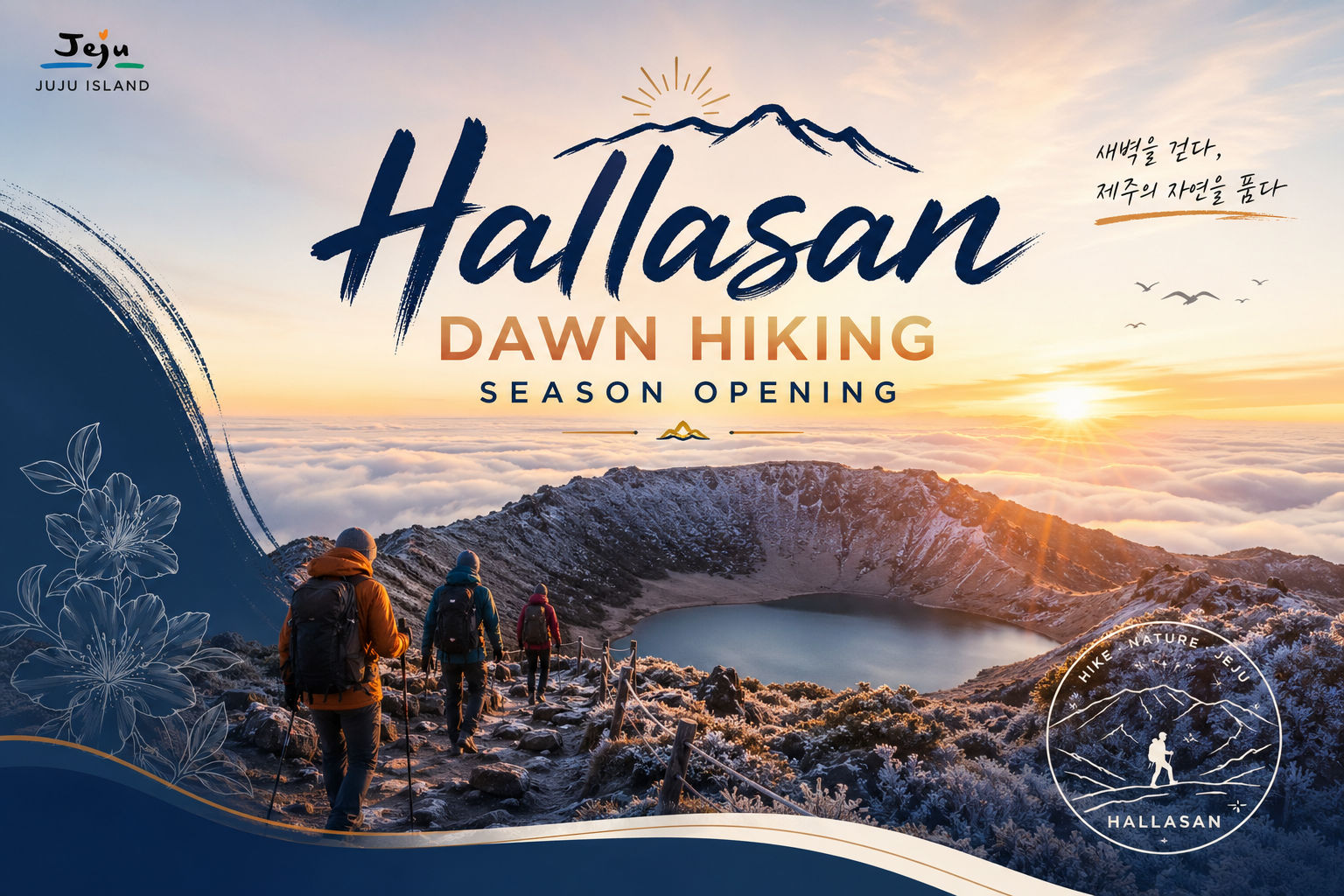
Hallasan Dawn Hiking 2026 — South Korea's Highest Summit at First Light
There is a very specific experience waiting for anyone willing to start walking at 5:00 AM on the slopes of Hallasan on Jeju Island. It starts in the dark, moves through the pre-dawn forest with the sounds of the mountain coming alive around you, and — if the weather cooperates and you clear the mandatory checkpoint in time — finishes at the rim of a volcanic crater containing a lake at 1,947 metres above the sea, with all of Jeju spread below and the sun rising over the Pacific horizon.
This is not a festival or a ticketed event. It is simply what happens when you show up at a Hallasan trailhead when the gates open at 5:00 AM.
"It starts in the dark, moves through the pre-dawn forest with the sounds of the mountain coming alive around you."
Trails Open Now
Before diving into everything about Hallasan's dawn hiking experience, a transparent note for anyone searching for an official "Hallasan Dawn Hiking Season Opening" event or ceremony: no such designated opening event exists.
Hallasan National Park's trails operate on a seasonal schedule throughout the year — opening and closing based on weather conditions, safety assessments, and monthly permit reservations. There is no single opening day or launch event for a "dawn hiking season."
What does exist and is fully confirmed for 2026:
- The trails are open right now (confirmed operating as of April 2026)
- The April to September window is when the earliest 5:00 AM trailhead opening applies, making it the true "dawn hiking" window before the October-March schedule shifts the entry cutoff to 11:30 AM
- The peak dawn hiking seasons are April–May and October–November for best weather and scenery
- Summit permits for the two summit trails must be booked in advance through the official reservation system
Jeju's Defining Mountain
Hallasan (한라산) rises to 1,947 metres (6,388 feet) above sea level at the centre of Jeju Island — the highest mountain in South Korea and the dormant shield volcano whose eruptions over hundreds of thousands of years built the island itself from the sea floor up.
The mountain is a UNESCO World Natural Heritage Site (inscribed 2007 as part of the Jeju Volcanic Island and Lava Tubes complex) and a UNESCO Biosphere Reserve — recognising both its geological significance and its extraordinary ecological diversity, which transitions from subtropical forest at the base through temperate mixed forest, subalpine zones, and exposed volcanic rock at the summit rim.
The summit crater: Baengnokdam
At the very top of Hallasan sits Baengnokdam — a volcanic crater lake whose name translates as "White Deer Lake," from the legend that white deer drank from its waters. The lake sits at the centre of the crater rim and reflects the sky and surrounding peaks on calm days — one of the most unusual and beautiful natural features accessible on any hiking trail in Korea.
"The mountain has a dramatic profile visible from virtually every part of Jeju Island."
Trail Options
Hallasan National Park has five main hiking trails, each offering a distinct character and difficulty level.
Summit Trails (permit required)
Seongpanak Trail:
- Length: 9.6km one way from trailhead to summit
- Duration: Approximately 4-5 hours one way; 8-9 hours round trip
- Character: A longer, more gradual ascent through dense forest, particularly beautiful in autumn (maple and oak foliage) and spring (azaleas); the most popular summit route
- Mandatory checkpoint: Jindallaebat Shelter — must pass by 12:30 PM (April–September) or 11:30 AM (October–March)
- From Jeju City: Approximately 30 minutes by car
- From Seogwipo City: Approximately 40 minutes by car
Gwaneumsa Trail:
- Length: 8.7km one way from trailhead to summit
- Duration: Approximately 5-7 hours round trip
- Character: The most dramatic and rugged summit route, with steeper sections, deeper forest, waterfalls, and the most technically demanding terrain of any Hallasan trail. The most rewarding for experienced hikers
- Mandatory checkpoint: Samgakbong Shelter — must pass by 12:30 PM (April–September) or 11:30 AM (October–March)
- From Jeju City: Approximately 25 minutes by car
Non-Summit Trails (no permit required)
Eorimok Trail:
- Length: 5.8km one way to Witseoreum Shelter (no summit access)
- Character: Accessible year-round, this trail passes through one of Hallasan's most beautiful meadows — the Witseoreum plateau with sweeping views and dense populations of Jeju azalea, which bloom in April and May in vivid pink across the hillside
- From Jeju City: Approximately 25 minutes
Yeongsil Trail:
- Length: 3.7km one way to Witseoreum Shelter
- Character: The most visually dramatic non-summit route, starting at the Yeongsil valley and climbing through rocky volcanic formations and unique stone pillar landscapes before reaching the same plateau as Eorimok. Shorter but more visually intense than the other non-summit routes
- From Seogwipo City: Approximately 30 minutes
Donnaeko Trail:
- Length: 7km one way
- Character: The quietest and least-visited of Hallasan's main trails, on the southern slope of the mountain. Follows a forested valley with streams and waterfalls, offering a more solitary hiking experience than the busier north-side trails
- From Seogwipo City: Approximately 25 minutes
Dawn Hiking Experience
The 5:00 AM trailhead opening from April through September is the specific window that makes Hallasan dawn hiking unlike almost any other experience available on the island.
What the dawn ascent looks like on the Seongpanak or Gwaneumsa trail:
- 5:00 AM — Gate opens. The forest is still dark, cool (April-May: 8-15°C at the trailhead; June-September: warmer and more humid), and quiet. The first 30-45 minutes of hiking happen largely in darkness or the very first grey light of pre-dawn. The sounds are entirely natural — wind in the forest canopy, the occasional bird beginning the dawn chorus
- 6:00-7:00 AM — Light arrives fully. The forest comes into its full colour — deep green in summer, extraordinary gold and scarlet in autumn, pale fresh green in spring. Other hikers begin appearing on the trail from the 6:00-7:00 AM groups
- 8:00-10:00 AM — The upper trail sections open. Weather on the summit can change rapidly — the peak is frequently in cloud even when the lower slopes are clear; hikers who begin at 5:00 AM reach the upper sections in the late morning before the afternoon cloud and weather typically builds
- Summit (if cleared checkpoint) — The crater rim and Baengnokdam crater lake, usually reaching midday or early afternoon for 5:00 AM starters on the Seongpanak trail. The view extends across all of Jeju and, on the clearest days, to the Korean mainland to the north and the Japanese island of Tsushima to the east
The critical checkpoints — do not miss these:
- Seongpanak → Jindallaebat Shelter: must arrive by 12:30 PM (April–September)
- Gwaneumsa → Samgakbong Shelter: must arrive by 12:30 PM (April–September)
- Hikers who do not clear the checkpoint by the cutoff time must turn back — rangers enforce the cutoff strictly for safety. A 5:00-6:00 AM start comfortably clears the checkpoint; starting at 8:00 AM is possible but tighter on the longer Seongpanak route
"The 5:00 AM trailhead opening from April through September is the specific window that makes Hallasan dawn hiking unlike almost any other experience available on the island."
Summit Permit System
Since the introduction of the Hallasan Summit Permit (reservation system), hiking the Gwaneumsa or Seongpanak summit trails requires advance booking.
How the reservation system works:
- Reservations are made through the official Hallasan National Park reservation website: visithalla.jeju.go.kr
- Reservations open on the 1st of each month and cover dates through the end of the following month — for example, booking on June 1 allows you to reserve any date through July 31
- Select your trail (Seongpanak or Gwaneumsa), date, and number of people
- The reservation is for the specific trail on a specific date — not a timed slot within the day
- The non-summit trails (Eorimok, Yeongsil, Donnaeko) do not require permits
Planning your booking around the monthly release:
- Summer dates (July–August) fill quickly — book on the 1st of the month, as slots for popular dates can sell out within hours of release
- April–May and October–November peak hiking season dates also fill fast
- If your travel dates change, cancellation and rebooking is available through the same system
Seasonal Highlights
April–May (Spring Peak):
The most celebrated dawn hiking season. The Eorimok and Yeongsil plateau trails are carpeted in Jeju azalea (Royal azalea / Rhododendron schlippenbachii) — dense pink blooms covering the highland meadows in vivid colour visible from the trail from the first light of the 5:00 AM start. Summit trail conditions are clear, crisp, and excellent for visibility. Trail temperatures at the summit remain cool (2-10°C) while the base is comfortable (8-18°C). Cherry blossoms at lower elevations peak in late March to early April.
June–July (Early Summer):
The mountain turns deeply, richly green. Hydrangeas bloom on the lower trail sections in June and July — large blue-purple clusters along the forest margins. The pre-dawn start in June and July begins in warmth (18-22°C at trailhead) with high humidity building as the day progresses. Summer morning cloud on the summit is possible, and afternoon weather builds from around 1:00 PM — the dawn start is particularly valuable in summer to reach the summit before afternoon conditions develop.
August (Late Summer):
Peak summer heat at the base (28-30°C by 9:00 AM); the summit remains cooler (10-18°C). The 5:00 AM start is at its most valuable in August — the pre-dawn ascent happens in the coolest window before the day heats up. Typhoon season is active in August; always check the Hallasan National Park website for trail closures before setting out.
October–November (Autumn Peak):
Hallasan's most spectacular visual season. The forest transitions through gold, orange, and deep red foliage — the Seongpanak trail is particularly celebrated for its autumn maple colours, and the Gwaneumsa valley's foliage is among the most photographed natural scenery in all of Korea. Note that from October onward, the checkpoint cutoff shifts to 11:30 AM, making the 5:00 AM start even more essential for summit clearance.
"Hallasan's most spectacular visual season. The forest transitions through gold, orange, and deep red foliage."
Practical Information
Trail access and fees:
- Trail entry: Free for all Hallasan National Park trails
- Parking: approximately 4,000 KRW (~3 USD) at trailhead parking areas
- Summit permit required for Gwaneumsa and Seongpanak trails — book at visithalla.jeju.go.kr
- Non-summit trails (Eorimok, Yeongsil, Donnaeko): no permit required, no advance booking needed
Trail opening hours (2026):
- Summit trails open: 5:00 AM
- Entry cutoff (April–September): 12:30 PM at the mandatory checkpoints
- Entry cutoff (October–March): 11:30 AM at the mandatory checkpoints
- For dawn hiking, the recommended start window is 5:00 AM to 8:00 AM
Getting to the trailheads from Jeju City:
- Eorimok: 25 min / Gwaneumsa: 25 min / Seongpanak: 30 min
Getting to the trailheads from Seogwipo City:
- Yeongsil: 30 min / Donnaeko: 25 min / Seongpanak: 40 min
What to bring for a Hallasan dawn hike:
- Headlamp or torch for the 5:00 AM start in the dark, particularly in spring and autumn when sunrise is later
- Layers — the summit can be 10-15°C colder than the trailhead regardless of season; even summer summit visits require a wind layer
- Hiking shoes with ankle support — the Gwaneumsa trail especially has rocky, uneven terrain in the upper sections
- Sufficient water for a 4-9 hour round trip (limited water sources on upper sections)
- Snacks and lunch — no food vendors on the trail above the trailhead area
- Crampons (November–March) — the upper sections carry ice and packed snow in winter, and crampons are required for safety on the summit trails from late autumn through early spring
- Trail permit confirmation — have your reservation on your phone or printed for the checkpoint rangers
- Check the Hallasan National Park website and Korean weather forecast the morning of your hike — trail closures due to weather happen with little advance warning
Emergency and safety:
- Ranger-guided options are available and recommended for first-time hikers
- Emergency shelters exist at key points on all summit trails
- The mandatory checkpoint system is specifically designed to prevent hikers from being caught at altitude in the dark — take the cutoff times seriously
Frequently Asked Questions
Is there an official "Hallasan Dawn Hiking Season Opening" ceremony or event in 2026?
No. There is no designated opening ceremony or annual event called the "Hallasan Dawn Hiking Season Opening." Hallasan National Park trails operate year-round on a seasonal schedule without a single opening day. The trails are fully open as of April 2026, with both summit trails opening daily at 5:00 AM. The prime dawn hiking windows are April–May (spring azaleas) and October–November (autumn foliage), with the April–September schedule offering the latest entry cutoff of 12:30 PM at the mandatory checkpoints.
Do I need a permit to hike Hallasan in 2026?
Yes, a summit permit is required for both the Gwaneumsa Trail and the Seongpanak Trail — the only two routes that reach the Hallasan summit (1,947m) and the Baengnokdam crater lake. Permits are free and booked through the official reservation system at visithalla.jeju.go.kr. Reservations open on the 1st of each month for dates through the end of the following month. The three non-summit trails (Eorimok, Yeongsil, Donnaeko) require no permit.
What time do Hallasan trails open for dawn hiking?
Both summit trails (Gwaneumsa and Seongpanak) open at 5:00 AM daily. The mandatory checkpoint cutoffs are 12:30 PM (April–September) and 11:30 AM (October–March) — hikers who do not reach the checkpoint by the cutoff must turn back. A start between 5:00 AM and 8:00 AM is recommended for summit attempts; the 5:00 AM start is ideal for the Seongpanak trail (9.6km one way) to comfortably clear the 12:30 PM checkpoint.
What is the best month for a dawn hike on Hallasan in 2026?
April to May is the most celebrated period — the Eorimok and Yeongsil plateau trails are covered in Jeju azalea (royal azalea) blooms, summit conditions are clear and crisp, and temperatures at the trailhead are comfortable for an early morning start. October to November is the autumn peak — Seongpanak and Gwaneumsa trail foliage is some of the most spectacular in Korea. For summer dawn hiking, June and early July offer hydrangea blooms on lower sections and deep green forest, though humidity and typhoon season risk must be factored in from August.
How long does it take to hike to the Hallasan summit?
The Seongpanak Trail (9.6km one way) takes approximately 4-5 hours to the summit, making it an 8-9 hour round trip. The Gwaneumsa Trail (8.7km one way) takes approximately 5-7 hours round trip. Both trails are free to access (parking ~4,000 KRW), and a summit permit is required in advance. A 5:00-6:00 AM start comfortably allows summit completion before the 12:30 PM checkpoint cutoff. Bring sufficient water, snacks, layers, and a headlamp for the pre-dawn section.
Verified Information at a Glance
- Mountain: Hallasan (한라산), Jeju Island, South Korea
- Summit elevation: 1,947 metres (6,388 feet) — South Korea's highest peak
- UNESCO status: World Natural Heritage Site (2007); Biosphere Reserve
- Summit crater lake: Baengnokdam (White Deer Lake)
- "Dawn Hiking Season Opening" event: Does not exist — trails operate year-round on seasonal schedule
- Current status (April 2026): Fully open, daily from 5:00 AM
- Trail opening time: 5:00 AM (all trails)
- Entry cutoff — April to September: 12:30 PM at mandatory checkpoints
- Entry cutoff — October to March: 11:30 AM at mandatory checkpoints
- Recommended dawn start: 5:00 AM to 8:00 AM
- Five main trails: Seongpanak (9.6km, summit), Gwaneumsa (8.7km, summit), Eorimok (5.8km, non-summit), Yeongsil (3.7km, non-summit), Donnaeko (7km, non-summit)
- Summit permit required: Gwaneumsa and Seongpanak trails only
- Permit booking: visithalla.jeju.go.kr — opens 1st of each month for dates through end of following month
- Trail entry fee: Free
- Parking: ~4,000 KRW (~3 USD)
- From Jeju City: Eorimok 25 min; Gwaneumsa 25 min; Seongpanak 30 min
- From Seogwipo City: Yeongsil 30 min; Donnaeko 25 min; Seongpanak 40 min
- Peak hiking seasons: April–May (azaleas, spring clarity); October–November (autumn foliage)
- Summer hiking: June–September — hydrangeas (June–July); heat and humidity; typhoon risk August
- Winter hiking: December–February — snow; crampons required on summit trails
- Essential kit: Headlamp, layers, hiking boots, water, snacks/lunch, permit confirmation