
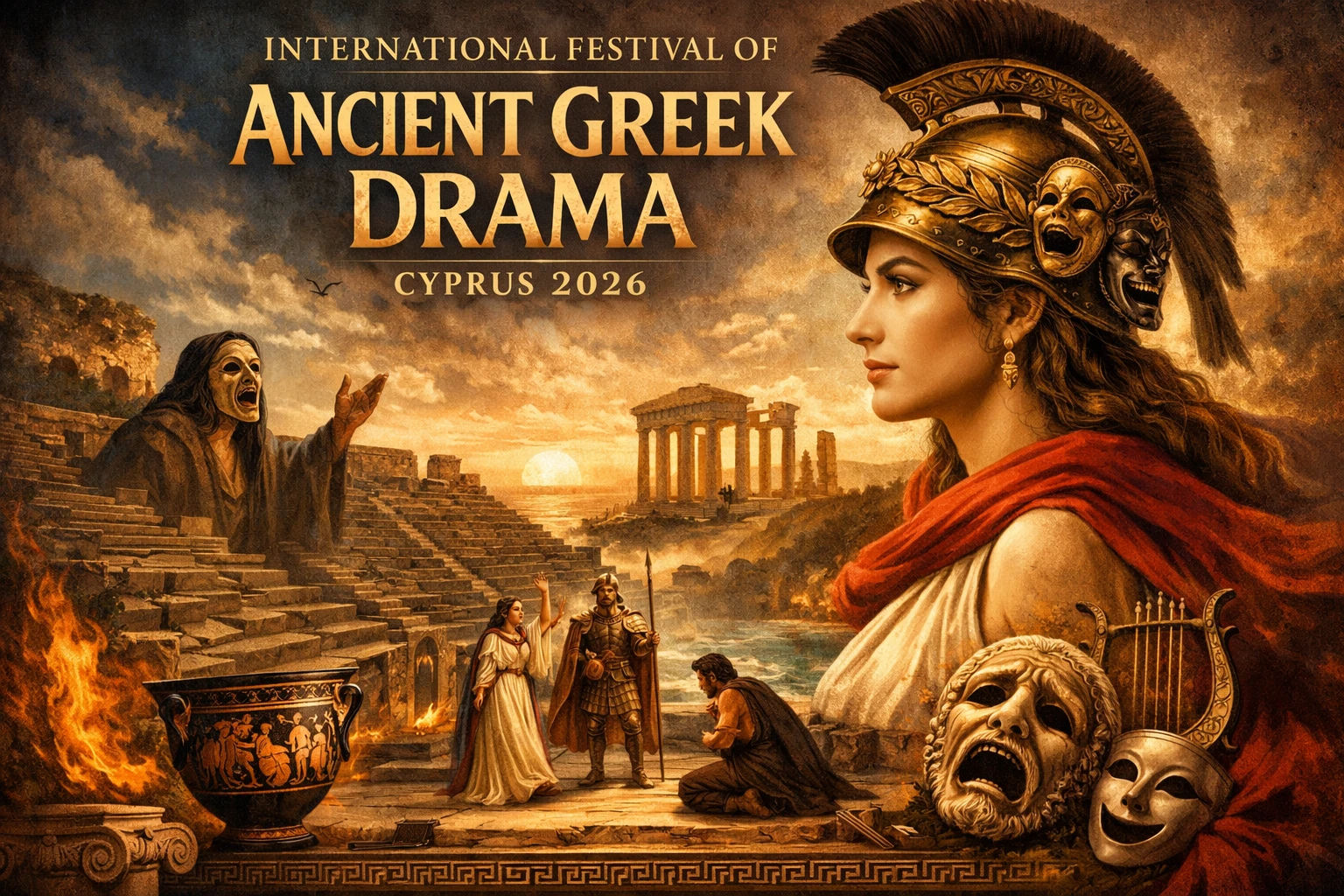
International Festival of Ancient Greek Drama Cyprus 2026: Where 2,500-Year-Old Stories Come Alive Under the Mediterranean Sky
There are very few places in the world where you can watch a 2,500-year-old play performed in an ancient stone theatre, under the stars, with the sea visible beyond the stage, and feel with absolute certainty that this is exactly the right setting for exactly this kind of story. Cyprus is one of those places. And the International Festival of Ancient Greek Drama is the annual proof that theatre, when performed with the right combination of setting, skill, and artistic seriousness, can transcend every language barrier and every century that separates the words from the world they were written for.
The 29th edition of the International Festival of Ancient Greek Drama will be held from early July until early August 2026 across the island of Cyprus, with performances at three extraordinary outdoor venues: the Curium Ancient Theatre in Limassol, the Ancient Odeon in Paphos, and the Makarios III Amphitheatre in Nicosia. Theatre companies from across the world will perform works by Sophocles, Euripides, Aeschylus, and Aristophanes in their own languages, each production bringing a distinct national and cultural perspective to stories that have been told on stages continuously for over two millennia.
Based on the established pattern of recent editions, the 2026 festival is expected to run from approximately July 8 to August 1, 2026. The official 2026 programme and confirmed dates will be published at greekdramafest.com ahead of the opening night.
29 Years of Ancient Drama
Cyprus: A Premier Stage
The International Festival of Ancient Greek Drama was founded in 1997, born from the recognition that Cyprus sits at a unique crossroads of geography, history, and culture that makes it genuinely one of the finest possible homes for a festival dedicated to the art form that lies at the foundation of all Western theatre.
"The mission has succeeded emphatically across 28 editions."
The festival is co-organised by three of the island's most important cultural institutions:
- The Cyprus Centre of the International Theatre Institute
- The Department of Contemporary Culture of the Deputy Ministry of Culture
- The Deputy Ministry of Tourism
This combination of theatre, culture, and tourism bodies reflects the festival's dual mission from the start: to create a genuinely world-class arts event that is also a genuine driver of cultural tourism to Cyprus, attracting international visitors who come specifically to experience this unique programme in these unique settings.
The mission has succeeded emphatically across 28 editions. Theatre companies from across Europe, the Americas, Asia, Africa, and the Middle East have participated, each presenting ancient texts in their own language with their own cultural interpretation. The accumulated effect of 28 years of international perspectives on the same canonical texts is a festival with an extraordinary depth of comparative artistic experience: you can watch Sophocles' Antigone interpreted by a Cypriot company, then see how an Italian ensemble or a Japanese theatre group approaches the same story, and understand in an immediate, embodied way that these plays are genuinely universal rather than merely classics.
The Venues
Where Ancient Stones Meet Stories
The International Festival of Ancient Greek Drama is inseparable from its venues, and the three outdoor amphitheatres it uses represent not only extraordinary theatrical spaces but also some of the most historically and archaeologically significant performance sites in the entire Mediterranean.
Curium Ancient Theatre, Limassol
The Curium Ancient Theatre (also written as the Kourion Theatre) is the most dramatically situated of the festival's three venues, built into the clifftop above the Kourion Archaeological Site on the southern coast of Cyprus, approximately 18 kilometres west of Limassol.
"On a clear evening during a festival performance, the combination of the ancient stone stage, the ancient play, and the ancient sea visible beyond creates a sensory experience that no purpose-built theatre can manufacture."
The theatre was originally built in the 2nd century BCE and extensively renovated by the Romans in the 2nd century AD, with further restoration work in modern times allowing it to function again as a working performance space. It seats approximately 3,500 people in a semicircular arrangement of limestone tiers, with the stage set against a backdrop of open Mediterranean Sea that stretches to the horizon.
The broader Kourion site, one of the most important archaeological complexes in Cyprus, includes ruins of an early Christian basilica, Roman floor mosaics, and the House of Eustolios with its extraordinary 5th-century mosaic depicting the figure of Ktisis (Creation). Arriving early for a festival performance and spending the late afternoon exploring the site before the show begins is one of the most satisfying combinations of archaeology and theatre available anywhere in the world.
Ancient Odeon, Paphos
The Ancient Odeon in Paphos is a smaller, more intimate venue: a well-preserved 2nd-century Roman theatre built from limestone blocks, seating approximately 1,200 people and situated within the Paphos Archaeological Park, a UNESCO World Heritage Site that is one of the most concentrated collections of Roman-era mosaics anywhere in the world.
The Paphos Ancient Odeon sits within walking distance of the extraordinary House of Dionysus, House of Theseus, and House of Aion mosaics, arguably the finest collection of ancient floor mosaics in existence outside of Italy. Performing ancient Greek drama in a Roman theatre surrounded by mosaic floors depicting the very mythological figures those dramas celebrate creates a cultural layering that is genuinely unique to Cyprus.
The harbour of Paphos is visible from the upper tiers of the Odeon, with the medieval Paphos Castle at the harbour entrance visible in the middle distance, adding a further layer of historical depth to the performance experience.
Makarios III Amphitheatre, Nicosia (Aglantzia)
The Makarios III Amphitheatre in the Aglantzia district of Nicosia, also referred to as the "Skali" Amphitheatre, is a modern open-air theatre that serves as the festival's Nicosia venue. Though it lacks the archaeological antiquity of the Curium and Paphos venues, it compensates with excellent modern facilities, good sightlines, and the particular energy of a capital-city audience experiencing the festival in the heart of the island.
Nicosia (Lefkosia) is the only divided capital city in the world, with the United Nations Buffer Zone running through its centre and the walled medieval city of the Venetian period straddling both the Greek Cypriot and Turkish Cypriot sides of the divide. A festival visit to the Makarios III Amphitheatre can be combined with exploration of the Old City of Nicosia, the Ledra Street crossing point, and the remarkable combination of Byzantine, Venetian, and Ottoman monuments that make the Cypriot capital one of the most historically layered cities in the Eastern Mediterranean.
The Festival Programme
International Productions
The structure of the International Festival of Ancient Greek Drama is one of its most distinctive and most intellectually engaging qualities.
"The result is a festival programme that is simultaneously about ancient Greek drama and about the extraordinary diversity of ways that humanity has found to tell these stories across different cultures and theatrical traditions."
Rather than presenting all performances in a single language or commissioning new adaptations for a unified house style, the festival invites theatre companies from across the world to perform ancient Greek drama in their own language, each bringing their own cultural interpretation and theatrical tradition to the same canonical texts.
English surtitles are provided for most international productions, allowing Anglophone audiences to follow all performances regardless of the performance language.
The festival programme typically features 6 to 8 productions across the 25-day run, with each production performing at two or three venues across the three cities. A Cypriot production traditionally opens the festival, demonstrating the island's own relationship with the ancient texts before the international companies present their interpretations.
Past productions that give a sense of the quality and range of the programme:
- The Bacchae by Euripides (2025): Directed by Daniele Salvo, one of Italy's most celebrated directors of Greek tragedy, presented by the DIDE Cultural Association and Amenanos Festival
- Antigone by Sophocles (2023): A Cypriot production directed by Kostas Silvestros, opening the festival at the Makarios III Amphitheatre before moving to Paphos and Limassol
- Hippolytus by Euripides (2023): Directed by Katerina Evangelatos of the National Theatre of Greece
- The Bacchae by Euripides (2024): By the National Theatre of Greece, performed at the Curium Ancient Theatre
The recurring presence of Euripides, Sophocles, and Aeschylus in the programme reflects both the canonical status of these playwrights and the festival's commitment to the core ancient repertoire rather than extending to more loosely interpreted or contemporary-themed productions.
The Cultural Context
Cyprus: Crossroads of the Ancient World
The decision to base the International Festival of Ancient Greek Drama in Cyprus rather than in Greece itself is not arbitrary. Cyprus occupies a singular position in the history of ancient Greek culture.
"This layering of historical contexts is what makes watching ancient Greek drama in Cyprus different from watching it anywhere else."
The island was settled by Mycenaean Greeks in the 12th century BCE, bringing with them the Greek language, the Greek religion, and the Greek cultural traditions that would eventually produce the dramatic literature the festival celebrates. Unlike mainland Greece, Cyprus was subsequently ruled by a succession of empires, including the Assyrian, Egyptian, Persian, Ptolemaic, Roman, Byzantine, Arab, Crusader, and Ottoman, each leaving cultural traces without extinguishing the island's fundamental Hellenic identity.
The result is a culture of extraordinary layering: an island that is genuinely and continuously Greek in language, religion, and artistic tradition, surrounded by physical evidence of every major civilisation that has passed through the Eastern Mediterranean for three thousand years. The Mycenaean-era tombs at the Tombs of the Kings in Paphos, the Roman mosaics at the Kourion site, the Byzantine churches of the Troodos Mountains, and the Venetian walls of Nicosia are all within the same small island, all within reach of the same open-air theatre stages where the festival performs.
This layering of historical contexts is what makes watching ancient Greek drama in Cyprus different from watching it anywhere else. The plays are not being performed in a setting that merely evokes the ancient world. They are being performed within a landscape that has been continuously part of the Greek-speaking world since before those plays were written.
Practical Information for Visitors
Tickets, Venues, and Travel
Ticket Prices:
Based on the 2025 edition, ticket prices for the International Festival of Ancient Greek Drama are:
- Standard admission: €15 per person
- Concession rate: €10 per person (for students, senior citizens, National Guard members, large families, and unemployed visitors)
- Free admission for people with disabilities (booking required at least 7 days before the performance by calling 7000 2414)
Ticket Sales:
- Online at soldoutticketbox.com
- At STEPHANIS stores across all cities in Cyprus
- At the TIME OUT Kiosk in Paphos
Official Programme:
The full 2026 performance schedule, confirmed dates, and artist details will be published at greekdramafest.com. Follow @greekdramafest on Instagram for real-time announcements.
Performance Times:
All performances begin at 9:00 PM to take advantage of the beautiful conditions of the Cyprus summer evening when the intense daytime heat has faded and the outdoor theatres fill with warm, still air ideal for outdoor performance.
Getting to the Venues:
Curium Ancient Theatre (Limassol):
- Located approximately 18 kilometres west of Limassol city centre
- Accessible by taxi or hire car from Limassol in approximately 25 minutes
- Larnaca International Airport is approximately 75 kilometres away (55 to 60 minutes by car)
Ancient Odeon (Paphos):
- Located within the Paphos Archaeological Park, on the western seafront of Paphos
- Paphos International Airport is approximately 15 kilometres away (15 to 20 minutes by taxi)
- Limassol is approximately 65 kilometres east of Paphos (50 minutes by motorway)
Makarios III Amphitheatre (Nicosia/Aglantzia):
- Located in the Aglantzia district of Nicosia
- Larnaca International Airport is approximately 45 kilometres away (40 minutes by car)
- City buses and taxis serve the Aglantzia area from central Nicosia
What to bring to a festival performance:
The outdoor venues in July are warm even after 9:00 PM, with temperatures typically around 28 to 32°C in Limassol and Paphos and slightly cooler in Nicosia. Practical recommendations for attending:
- Light, loose clothing for the warm evening conditions
- A light layer for very late performances, particularly at the Curium site where the clifftop sea breeze can cool noticeably after midnight
- Comfortable shoes for the stone seating and terrain at the archaeological sites
- Water and light snacks (available at venue kiosks but worth bringing additional supplies)
- Arrive 30 to 45 minutes before the 9:00 PM performance time to find your seats, explore the venue, and enjoy the extraordinary setting in the last of the evening light
Beyond the Drama
Cyprus in July and August
The International Festival of Ancient Greek Drama runs through July and into early August, which coincides with Cyprus at the height of its summer season, when the island's beaches, mountain villages, archaeological sites, and waterfront towns are all at their most alive.
"Plan your Cyprus summer around these performances. Arrive early enough to watch the sun set over the sea from your seat at the Curium."
Between festival performances, Cyprus offers:
- The Akamas Peninsula National Park: The most pristine natural landscape in the Republic of Cyprus, with dramatic sea cliffs, the Blue Lagoon at Lara Bay, the remote beaches of the northwest, and walking trails through Mediterranean maquis
- The Troodos Mountain Villages: A complete change of atmosphere from the coastal heat, with stone-built villages, Byzantine painted churches (several UNESCO World Heritage listed), traditional Cypriot cuisine at village tavernas, and the famous winery visits of the Commandaria wine region
- Aphrodite Hills and the Aphrodite's Rock: The legendary Petra tou Romiou on the coast between Limassol and Paphos, where the sea goddess Aphrodite was said to have risen from the foam, provides a genuinely beautiful and mythologically resonant coastal stop on any journey between Limassol and Paphos festival venues
- The Tombs of the Kings, Paphos: The vast underground necropolis of Hellenistic and Roman-era rock-cut tombs carved into the coastal plateau near the Ancient Odeon, where the theatrical mythology of the festival takes on additional weight against the actual tombs of the ancient world
Frequently Asked Questions
When is the International Festival of Ancient Greek Drama 2026 in Cyprus?
The 29th edition of the International Festival of Ancient Greek Drama will take place from early July until early August 2026 in Cyprus. Based on the pattern of recent editions, this is expected to run from approximately July 8 to August 1, 2026. The official confirmed dates and full programme will be published at greekdramafest.com.
Where does the International Festival of Ancient Greek Drama take place in Cyprus?
The festival uses three open-air venues: the Curium Ancient Theatre in Limassol (18km west of the city), the Ancient Odeon in Paphos (within the UNESCO World Heritage Paphos Archaeological Park), and the Makarios III Amphitheatre in Nicosia (Aglantzia district). Each production typically performs at all three venues across the festival run.
How much are tickets for the International Festival of Ancient Greek Drama 2026?
Based on 2025 pricing: €15 for standard admission and €10 for concessions (students, senior citizens, National Guard members, large families, unemployed). Free admission is available for people with disabilities with advance booking (call 7000 2414 at least 7 days before the performance). Tickets are sold at soldoutticketbox.com, at STEPHANIS stores across Cyprus, and at the TIME OUT Kiosk in Paphos.
What plays are performed at the International Festival of Ancient Greek Drama?
The festival performs ancient Greek tragedies and comedies by Sophocles, Euripides, Aeschylus, and Aristophanes. Previous productions have included The Bacchae, Antigone, Hippolytus, and other canonical ancient texts, performed by international theatre companies in their own languages with English surtitles provided.
What time do performances start at the festival?
All festival performances begin at 9:00 PM, taking advantage of the beautiful conditions of the Cyprus summer evening.
How long has the International Festival of Ancient Greek Drama been running?
The festival was established in 1997 and the 2026 edition is the 29th in its history. It has run every summer since its founding and is now one of the most established and respected ancient drama festivals in the world.
Are there English surtitles at the festival performances?
Yes. English surtitles are provided for most international productions, making the performances fully accessible to Anglophone visitors regardless of which language the company is performing in.
Twenty-nine years of gathering under Cyprus's summer sky to hear stories that were first told when the world was entirely different and that still, with extraordinary stubbornness, refuse to stop being true.
The 29th International Festival of Ancient Greek Drama runs from early July to early August 2026, across three of the most spectacular open-air theatres in the Mediterranean. The programme will be published at greekdramafest.com. Tickets are at soldoutticketbox.com from €15 per person.
Plan your Cyprus summer around these performances. Arrive early enough to watch the sun set over the sea from your seat at the Curium. Stay late enough to feel the night air change around midnight when the last act ends and the ancient stones slowly cool. There is no other festival experience in the Eastern Mediterranean quite like this, and 2026 is the year to experience it.
Verified Information at a Glance
- Event Name: International Festival of Ancient Greek Drama 2026 (29th Edition)
- Event Category: Annual International Open-Air Theatre Festival
- Edition: 29th Annual
- Year Founded: 1997
- 2026 Dates: Early July to early August 2026 (expected approximately July 8 to August 1, 2026 based on established pattern)
- Duration: Approximately 25 days
- Venues:
- Curium Ancient Theatre, Limassol (18km west of city, clifftop above the sea)
- Ancient Odeon, Paphos (within UNESCO World Heritage Paphos Archaeological Park)
- Makarios III Amphitheatre (Skali), Aglantzia, Nicosia
- Performance Start Time: 9:00 PM
- Ticket Prices: €15 standard / €10 concessions (students, seniors, National Guard, large families, unemployed)
- Free Admission: People with disabilities (advance booking: call 7000 2414 at least 7 days before performance)
- Ticket Platforms: soldoutticketbox.com, STEPHANIS stores across Cyprus, TIME OUT Kiosk in Paphos
- Surtitles: English surtitles provided for most international productions
- Languages: Productions performed in original company language (multilingual international programme)
- Programme Genre: Ancient Greek drama (tragedies and comedies by Sophocles, Euripides, Aeschylus, Aristophanes)
- Co-organisers: Cyprus Centre of the International Theatre Institute, Department of Contemporary Culture (Deputy Ministry of Culture), Deputy Ministry of Tourism
- Official Website: greekdramafest.com
- Instagram: @greekdramafest
- Facebook: International Festival of Ancient Greek Drama
- Programme Publication: Full confirmed 2026 schedule available at greekdramafest.com (expected spring 2026)
- Nearest Airports: Larnaca International Airport (LCA), approximately 75km from Limassol, 45km from Nicosia; Paphos International Airport (PFO), approximately 15km from Paphos Ancient Odeon