
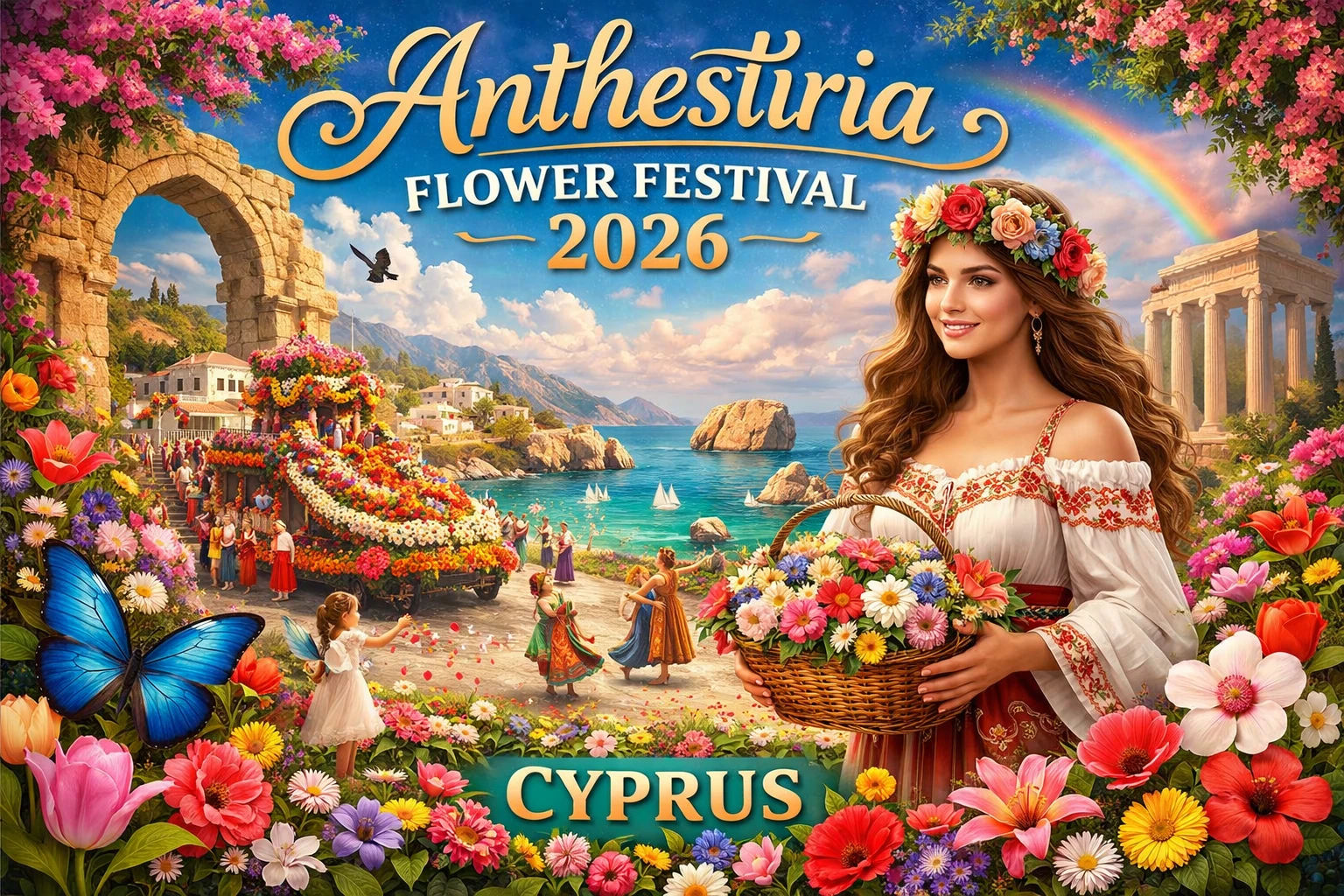
Anthestiria Flower Festival 2026 Cyprus: The Island's Most Colourful Celebration of Spring
When May arrives in Cyprus, the island does not quietly mark the transition from spring to summer. It parades it. It decorates floats with thousands of blooms. It lines the seafront promenades with schoolchildren in flower wreaths. It fills the air of three coastal cities simultaneously with brass bands, folk dancers, and the collective, joyful noise of communities that have been celebrating the return of flowers for nearly a century, on an island that has been celebrating it for far longer than that.
The Anthestiria Flower Festival 2026 takes place on Wednesday, May 6, 2026, with flower parades and festivities in Limassol (Germasogeia/Yermasoyia), Paphos, and Larnaca, the three cities that have traditionally hosted Cyprus's most important Anthestiria celebrations each year. The festival is completely free, open to everyone, and one of the most visually spectacular events in the entire Cyprus spring calendar.
The word itself comes from the ancient Greek: anthos, meaning flower. And that is precisely what the day is about: flowers, in every possible form, filling every available surface, covering floats, adorning the hair and clothes of participants, decorating stages and streetfronts, and transforming the ordinary promenades and avenues of three Mediterranean coastal cities into something that looks, for one extraordinary day, like a painting that has come to life.
"The festival is completely free, open to everyone, and one of the most visually spectacular events in the entire Cyprus spring calendar."
Ancient Roots, Modern Celebration
From Athens to Cyprus
The Anthestiria has been celebrated in Cyprus every spring for generations, but its roots go back far deeper than even the oldest living memory of the festival in its current form.
In ancient Athens, the Anthestiria was one of the most important festivals in the Greek religious calendar, a three-day celebration held in February or March in honour of Dionysus, the god of theatre, wine, and fertility. It was simultaneously the festival of flowers and the festival of souls, celebrating three interlocking ideas that the ancient Greeks understood as aspects of the same truth: the return of spring, the renewal of the cycle of life, and the presence of the spirits of the dead who were believed to return to the world of the living during the festival days.
The name was derived from anthos (flower), and the festival celebrated the blooming of the spring flowers as a physical manifestation of nature's renewal. Dionysus was the presiding deity not simply because of his association with wine (the vine being the plant that most conspicuously dies in winter and returns in spring) but because he represented the generative, celebratory, life-affirming energy of the natural world at its most abundant.
Cyprus has maintained a living connection to this ancient festival tradition through the Orthodox Christian calendar and through the specific relationship between the island's spring blooming season and the cultural memory of a people who have been growing things in this soil for three thousand years. The Paphos Anthestiria holds particular historical significance: the Paphos festival has been running continuously since the early 20th century, and the 2026 edition is the 97th in the city's modern festival history. In a festival with this kind of unbroken heritage, every flower float is carrying more history than it might appear to.
"In a festival with this kind of unbroken heritage, every flower float is carrying more history than it might appear to."
2026 Festival: Three Cities, One Day
Anthestiria Across Cyprus
The Anthestiria Flower Festival 2026 takes place on May 6, 2026, simultaneously in the three cities that have been the principal celebration centres for the modern Cypriot festival tradition.
Larnaca:
Larnaca's Anthestiria parade takes place at the Finikoudes (Palm Trees) Promenade, on Athinon Avenue, beginning at 18:00 (6:00 PM) with entertainment on the seafront stage from 19:30. The parade of flower-decorated floats moves along the promenade and through the town centre, featuring participation from local organisations, schools, and community groups. Spectators line both sides of the promenade as the floats pass, and the combination of the decorated floats, the folk performance groups, and the Larnaka Fort visible at the end of the promenade provides one of the most visually characteristic Anthestiria settings in Cyprus. The festival culminates with a rich artistic programme on the Central Stage of the seafront.
Limassol (Germasogeia/Yermasoyia):
Limassol's Anthestiria is hosted by the Yermasoyia municipality (the coastal municipality that forms part of the greater Limassol urban area), with the flower parade running along Georgiou A' Street and the broader Amathountos Avenue area. The parade is followed by concerts featuring well-known Cypriot and Greek artists performing on the seafront stage. The Yermasoyia Anthestiria is specifically focused on the spectacular parade of flower-decorated floats, with local organisations and businesses competing to create the most elaborately and beautifully decorated float, and the judging of the best float being one of the most anticipated elements of the day.
Paphos:
Paphos holds one of the oldest continuously running Anthestiria celebrations in Cyprus. The Paphos flower parade follows Poseidonos Avenue toward the old harbour, with flower floats passing alongside girls holding bouquets and wreaths, and the air filled with fragrances, music, and the festive atmosphere that the old harbour setting, with its medieval Paphos Castle at the water's edge, amplifies into something genuinely extraordinary. After the parade, the celebration continues with concerts, contests, and shows at the harbour area.
"The air filled with fragrances, music, and the festive atmosphere that the old harbour setting amplifies into something genuinely extraordinary."
Festival Experience: Flowers, Floats, Music
Joy of Spring in One Day
The Anthestiria Flower Festival is a relatively compact event in terms of its primary programme (the parade is typically two to three hours) but the density of sensory experience it packs into those hours makes it one of the most memorable events on the Cyprus calendar.
The decorated flower floats:
The floats are the defining element of the entire festival and the element that requires the most preparation. Local schools, community organisations, businesses, and cultural groups spend weeks before the festival constructing and decorating their floats with fresh and dried flowers, creating tableaux that range from mythological scenes to contemporary artistic statements to straightforwardly beautiful floral arrangements. At the Larnaca and Paphos parades, the floats are judged competitively, with prizes awarded for the most beautifully decorated, adding a competitive edge that increases the creative investment of the participating groups. The scale and ambition of the best floats, which can use tens of thousands of individual blooms to cover every surface, must be seen to be fully appreciated.
The flowers themselves:
Cyprus in May is botanically extraordinary. The island is home to approximately 2,000 plant species, of which roughly 150 are endemic, found nowhere else in the world. May is the peak of the spring flowering season, when the roadside verges across the island are thick with wild flowers, the cultivated gardens of the cities are at their most abundant, and the agricultural fields of the coastal plains and mountain foothills are flowering ahead of the summer harvest. The Anthestiria celebration uses the flowers of this specific moment: locally grown blooms, Cypriot endemic species, cultivated garden flowers, and the wild flowers that grow on the island's hills and coastal slopes.
Music and performance:
Each city's Anthestiria programme includes live musical performances following the parade, typically featuring:
- Traditional Cypriot folk music and dance groups in full festival costume
- Popular Greek and Cypriot musical acts performing on outdoor stages, reflecting the broader contemporary entertainment culture of the cities alongside the traditional folk elements
- School choir and performance groups who participate both in the parade and in the stage programme
- The announcement and awarding of prizes for the best-decorated floats, typically one of the most enthusiastically attended moments of the evening programme
Children and schools:
The Anthestiria has always been particularly connected to schools and young people, and the participation of schoolchildren in the parades, dressed in flower wreaths and carrying bouquets, is one of the most charming and most photographed elements of the festival. In Cyprus's educational tradition, the Anthestiria is treated as a genuine cultural education event, with children learning about the ancient Greek origins of the festival and the botanical significance of Cyprus's spring flowering season alongside the practical activity of preparing their group's parade participation.
The flower fairs:
Alongside the parades, each city's Anthestiria includes flower markets and exhibitions where local growers, florists, and botanical enthusiasts present their plants and cut flowers for sale. These markets give visitors the opportunity to take a piece of the festival home with them, whether as a potted Cypriot endemic plant, a bouquet of locally grown blooms, or a wreath crafted from the island's spring flowers.
Cyprus's Spring Botanical Heritage
An Island in Full Bloom
The Anthestiria celebration makes most sense when you understand the botanical context it exists within: Cyprus in May is genuinely one of the most florally spectacular places in the Mediterranean.
The island's approximately 2,000 plant species, of which 150 are endemic, include some of the most beautiful and most distinctive flora in the Eastern Mediterranean. The Cyprus Cyclamen (Cyclamen cyprium), a small but extraordinarily beautiful endemic species with distinctive white-pink petals, is one of the most recognisable. The Cyprus Tulip (Tulipa cypria), with its deep red blooms, is another endemic species that has become a symbol of the island's botanical uniqueness.
May in Cyprus also brings:
- Wild poppies in the agricultural fields, covering the plains between Larnaca and the Troodos foothills with sheets of red that are among the most visually dramatic wildflower displays in the Mediterranean
- Rock roses (Cistus species) on the hillsides, their large white and pink flowers brief but extraordinarily beautiful
- Orchids: Cyprus hosts several endemic orchid species, including the Cyprus Bee Orchid (Ophrys kotschyi), which blooms in spring in the scrubland and mountain meadows of the island
- Oleander: The roadsides and water channels of Cyprus, and the planted gardens of the coastal cities, are lined with oleander that reaches its first bloom in May, providing the vivid pink and white splashes of colour that characterise Cypriot springtime landscapes
- Bougainvillea: The climbing bougainvillea that covers the walls and terraces of houses across the island reaches the height of its spring display precisely in the Anthestiria period, adding vivid purple and magenta to the floral palette of every city where the parade takes place
This natural abundance of spring flowering in Cyprus is not a backdrop to the Anthestiria. It is the reason for it.
Practical Information for Anthestiria 2026
Everything You Need Before May 6
Confirmed 2026 Details:
- Festival Date: Wednesday, May 6, 2026
- Cities: Larnaca, Limassol (Germasogeia/Yermasoyia), and Paphos
- Admission: Free throughout all three cities
Larnaca Anthestiria 2026:
- Venue: Finikoudes (Palm Trees) Promenade, Athinon Avenue, Larnaca
- Parade Start Time: 18:00 (6:00 PM)
- Stage Entertainment Start: 19:30
- Organiser: Municipality of Larnaca
- Bus Access: Stops "Grigori Afxentiou" or "Archiepiskopou Makariou III (Stasi 1)" on bus No. 425
- Note: Traffic may be closed along the promenade before the parade; plan arrival accordingly
Limassol (Yermasoyia) Anthestiria 2026:
- Venue: Georgiou A' Street and Amathountos Avenue area, Germasogeia
- Organiser: Yermasoyia Municipality
- Contact: Yermasoyia Municipality: +357 25315720
- Parade route: Georgiou A' Street (Amathountos area, near the seafront)
- Afternoon and evening programme with live concerts after the parade
Paphos Anthestiria 2026:
- Venue: Poseidonos Avenue toward the Paphos Old Harbour
- Organiser: Municipality of Paphos / Geroskipou Municipality (alternating years)
- Contact: Municipality of Paphos: +357 26822030
- Programme: Parade along Poseidonos Avenue + concerts and events at the harbour
Getting to the festival cities:
All three Anthestiria cities are within easy reach of Cyprus's two international airports:
- Larnaca International Airport (LCA) to Larnaca Finikoudes: 5 to 10 minutes by taxi
- Larnaca Airport to Limassol (Germasogeia): 55 minutes by car/taxi
- Paphos International Airport (PFO) to Paphos Harbour area: 15 minutes by taxi
- Larnaca Airport to Paphos: 90 minutes by car via A6/B6 motorway
What to wear and bring:
- Bright, colourful clothing is the spirit of the day; plain outfits are perfectly acceptable but the festival atmosphere rewards those who dress for the occasion
- A flower wreath or fresh blooms worn in the hair or on clothing is both traditional and entirely welcomed by participants and organisers
- Comfortable walking shoes for the parade routes, which involve standing on promenades and pavements for two to three hours
- The May 6 evening in Cyprus coastal cities is warm (approximately 22 to 25°C), so light summer layers are ideal
- A camera: the floats, the costumes, the flower-covered streets, and the combination of sea and spring flowers create some of the finest photography opportunities of the Cyprus spring season
Frequently Asked Questions
When is the Anthestiria Flower Festival 2026 in Cyprus?
The Anthestiria Flower Festival 2026 takes place on Wednesday, May 6, 2026, with flower parades and festivities in Larnaca, Limassol (Germasogeia/Yermasoyia), and Paphos.
What is Anthestiria and why is it celebrated in Cyprus?
Anthestiria is an ancient Greek festival originating in Athens, where it was held in honour of Dionysus, god of theatre and renewal, to celebrate the arrival of spring flowers. The festival celebrates the rebirth of nature, the blooming of spring, and the renewal of life. Cyprus has maintained the tradition for generations, with the Paphos celebration running continuously since the early 20th century (the 2026 edition is approximately the 97th).
Is the Anthestiria Flower Festival free to attend?
Yes. The Anthestiria Flower Festival is completely free to attend across all three cities. No tickets are required for either the parade or the evening concerts and stage programme.
Where does the Anthestiria parade take place in Larnaca?
The Larnaca Anthestiria parade takes place at the Finikoudes (Palm Trees) Promenade, Athinon Avenue, Larnaca, beginning at 18:00 (6:00 PM), with entertainment on the seafront stage from 19:30. Bus No. 425, stops "Grigori Afxentiou" or "Archiepiskopou Makariou III (Stasi 1)", serves the promenade area.
Which city has the best Anthestiria celebration in Cyprus?
Each city offers a different and equally authentic experience: Larnaca has the most celebrated and longest promenade setting, with the Finikoudes palms and Larnaka Fort forming a beautiful backdrop; Paphos has the most historically continuous tradition (approximately 97 editions) with the parade ending at the iconic Old Harbour; and Limassol (Germasogeia) has the most elaborate float competition and the most energetic concert programme. Many festival-goers choose based on which city they are staying in, or attend the nearest to their accommodation and move to a second city for the evening programme.
How long has the Anthestiria been celebrated in Cyprus?
The modern Anthestiria festival in Cyprus has been running since at least the early 20th century. The Paphos celebration has been running for approximately 97 consecutive years, making the 2026 edition one of the most historically continuous popular festivals in Cyprus. The festival's roots trace back to ancient Athens where similar celebrations were held in honour of Dionysus.
May 6, 2026. Three cities. One island in full, unrestrained bloom.
The Anthestiria Flower Festival is the day Cyprus stops to look at what spring has done to the landscape it grows from and decides to put it on a float, add music, line the seafront with thousands of people, and let the whole beautiful, fragrant, colourful abundance of it parade through the heart of the city for everyone to see.
Larnaca, Limassol, and Paphos are ready. The floats are being decorated. The wreaths are being woven. And the flowers of an island that grows 150 endemic plant species found nowhere else in the world are about to take centre stage. Show up in your brightest colours, wear a flower if you have one, and be part of the oldest spring celebration in the Mediterranean world, played out on one of its most extraordinary islands.
Verified Information at a Glance
- Event Name: Anthestiria Flower Festival 2026 (Γιορτή Ανθεστηρίων)
- Event Category: Annual Ancient Spring Flower Parade and Folk Festival
- Confirmed 2026 Date: Wednesday, May 6, 2026
- Admission: Free (all cities, all events)
- Celebrating Cities: Larnaca, Limassol (Germasogeia/Yermasoyia), and Paphos
Larnaca:
- Venue: Finikoudes Promenade, Athinon Avenue, Larnaca
- Parade Start: 18:00 / Stage Entertainment: 19:30
- Organiser: Municipality of Larnaca
- Contact: +357 24657745 / www.larnaka.org.cy
Limassol (Germasogeia/Yermasoyia):
- Venue: Georgiou A' Street, Amathountos Avenue area, Germasogeia
- Organiser: Yermasoyia Municipality
- Contact: +357 25315720
Paphos:
- Venue: Poseidonos Avenue toward Paphos Old Harbour
- Organiser: Municipality of Paphos
- Contact: +357 26822030
- Heritage: Running continuously since early 20th century (approximately 97th edition in 2026)
Festival Programme Elements (all cities): Decorated flower float parade (competitive judging), folk music and dance performances, evening concerts by popular Cypriot and Greek artists, flower market and exhibition, schoolchildren and community group participation
Visit Cyprus Listing: visitcyprus.com Annual Events 2026