
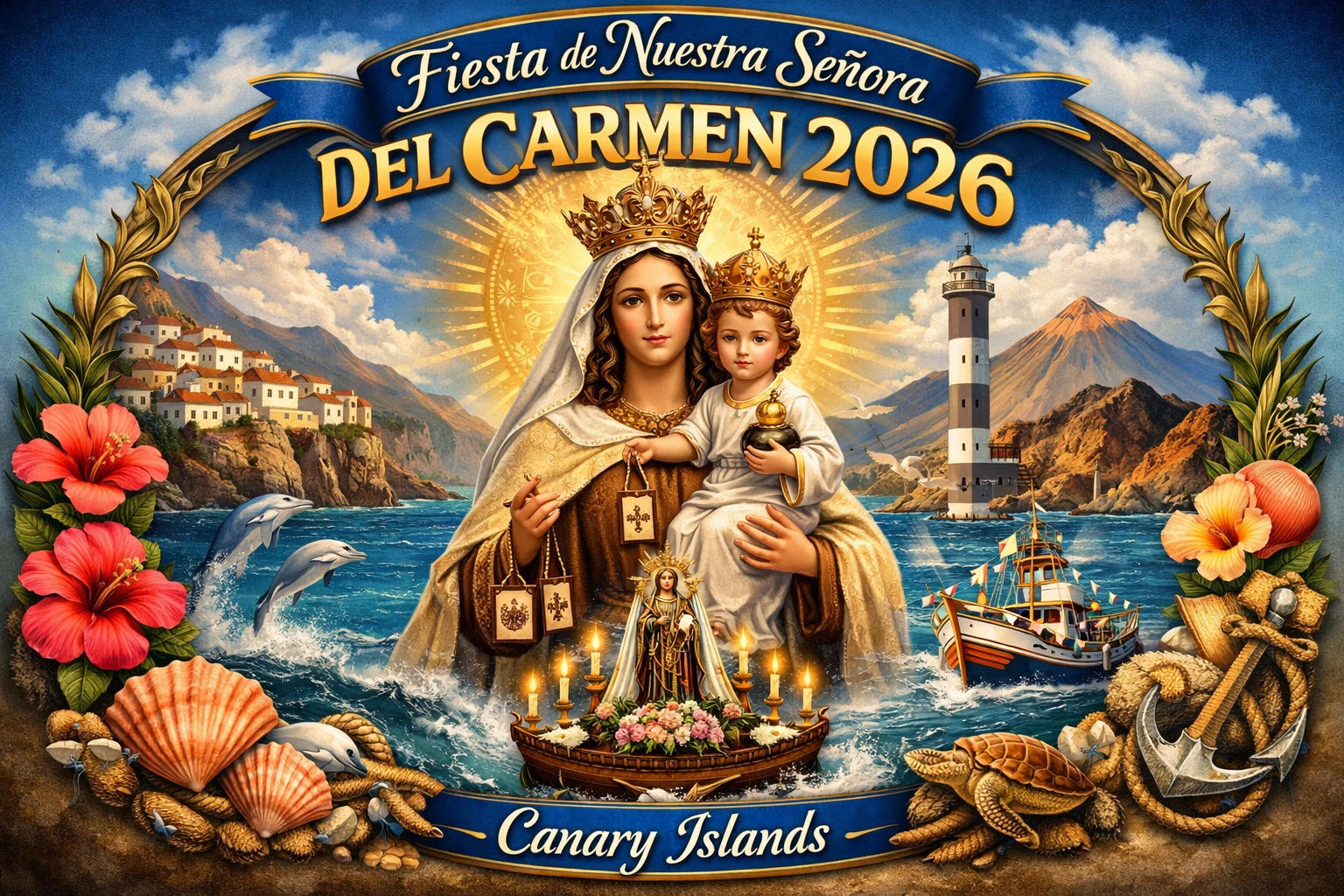
Fiesta de Nuestra Señora del Carmen 2026: The Canary Islands' Most Beloved Summer Celebration
There are festivals that entertain, and then there are festivals that genuinely move you. The Fiesta de Nuestra Señora del Carmen belongs firmly in the second category. Celebrated every July across the Canary Islands, this deeply rooted tribute to the patron saint of sailors and fishermen is one of the most emotionally powerful and visually spectacular events you will ever witness in Spain. Whether you are watching a decorated boat carry the statue of the Virgin across the shimmering waters of the Atlantic in Las Palmas, or standing on the waterfront in Puerto de la Cruz as the procession winds its way to the sea, the experience stays with you long after the summer has ended.
For 2026, the Fiesta de Nuestra Señora del Carmen will once again bring the islands to life with colour, devotion, music, and community. If you are planning a visit to the Canary Islands this summer and you happen to be there in July, do not miss it.
The Story Behind the Celebration
Who Is Nuestra Señora del Carmen?
Our Lady of Carmen, known in Spanish as La Virgen del Carmen or Nuestra Señora del Carmen, is venerated as the patron saint of fishermen, sailors, and the Spanish Navy. Her feast day falls on July 16th each year, a date that triggers celebrations in coastal communities throughout Spain. Given that Spain has over 3,000 miles of coastline and 60 islands, that works out to an enormous number of simultaneous celebrations happening around the same time.
In the Canary Islands, where the sea has always been the foundation of island life and culture, the devotion to this particular Virgin runs especially deep. Fishing communities across Gran Canaria, Tenerife, Lanzarote, and the rest of the archipelago have honoured her for generations. The bond between the islanders and the ocean is not just practical; it is spiritual, and the Fiesta del Carmen is where that spirituality becomes visible.
How the Celebration Evolved
While the religious tradition of honouring the Virgen del Carmen goes back centuries, the organised festival celebrations across the Canary Islands began taking shape in the mid-20th century. What started as quiet processions and private devotions gradually grew into full community events with official programmes, concerts, cultural performances, and activities for all ages.
Today, the fiesta has become one of the most consolidated summer celebrations across the entire archipelago. In Las Palmas de Gran Canaria alone, the festivities span almost the entire month of July, running from the 6th to the 28th. In Tenerife's Los Realejos, the programme stretches from July 2 to July 30. And in Lanzarote, celebrations take place across multiple locations throughout the summer, with the main festivities in Puerto del Carmen falling in August.
Where the Fiesta Is Celebrated Across the Canary Islands
Las Palmas de Gran Canaria
The celebrations in Las Palmas are anchored in two neighbourhoods that carry centuries of maritime history between them: La Isleta and San Cristóbal.
La Isleta is a fishing neighbourhood in the north of the city with steep streets, colourful staircases decorated in urban art, and a community character that is unlike anywhere else in Las Palmas. San Cristóbal, to the south, is equally charming, with small houses painted in a range of vivid colours that spill down toward the sea. Both neighbourhoods feel the fiesta intensely, and both are worth visiting during the celebrations.
The programme in Las Palmas typically includes:
A peal of bells at noon on July 6th to officially open the festivities, followed by an Announcing Parade through the neighbourhood streets.
Nightly concerts at Manuel Becerra Square, with Spanish and local music artists performing throughout the month.
A Dawn Procession on July 15th at 5:00 AM, when residents spend the entire night laying elaborate street carpets made of salt, sand, and rubber in preparation for the procession.
A fireworks display on July 16th at midnight, marking the official feast day of the Virgin.
Craft fairs, guided walking tours, excursions, and family activities organised by local associations.
The Maritime Procession on July 20th at 5:00 PM, when the statue of the Virgen del Carmen is carried from the temple through La Naval Street to the Port of La Luz, where it is placed aboard a Navy ship bearing her name and carried across the bay, accompanied by a flotilla of decorated smaller boats.
That maritime procession is the absolute highlight. The combination of the decorated ships, the chanting of the Salve, the crowd lining the port, and the presence of the Navy gives it a scale and solemnity that no photograph can fully capture.
Puerto de la Cruz, Tenerife
In Puerto de la Cruz on the north coast of Tenerife, the Fiesta del Carmen centres on July 15, 2026, with the main procession starting from the Iglesia de Nuestra Señora de la Peña de Francia in the central Plaza de la Iglesia.
Here, the statues of Our Lady of Carmen and San Telmo are carried through the streets following a solemn mass, then transported down to the harbour where they are loaded onto local fishing boats. A flotilla of decorated vessels then escorts them along the coastline in a display that draws enormous crowds every year. It is one of the most photographed religious events in the entire Canary Islands.
Los Realejos, Tenerife
In Los Realejos on Tenerife's northern coast, the Fiestas del Carmen are recognised as among the most important and emblematic in the entire municipality. The programme runs from July 2 to July 30, 2026, blending religious acts, land-and-sea processions, open-air dances, concerts, and displays of traditional Canarian folklore into a celebration that feels like a month-long community reunion.
Puerto del Carmen, Lanzarote
On the volcanic island of Lanzarote, the festivities in Puerto del Carmen hold a special significance. This resort town, named after the Virgen del Carmen herself, celebrates her patronage with a procession in which the Virgin's image is transported from the church to the sea in a decorated boat. This powerful symbolic gesture of handing the saint over to the water captures the island's relationship with the ocean in a way that is hard to put into words. The 2026 celebrations in Lanzarote are scheduled for August 2026.
The Heart of the Fiesta: The Maritime Procession
If there is one moment that defines the Fiesta de Nuestra Señora del Carmen across every island where it is celebrated, it is the maritime procession.
The image of the Virgin, often elaborately dressed and crowned, is carried by costaleros from the church through the streets, accompanied by local officials, clergy, musicians, and hundreds of devoted followers. When the procession reaches the water, the statue is carefully loaded onto a decorated boat, and the real spectacle begins.
Dozens of fishing boats and leisure vessels join the procession on the water, many of them covered in flowers, ribbons, and coloured lights. The bay fills with horns, chanting, and the low rumble of boat engines. People gather on the shore, on harbour walls, on balconies, and on rooftops to watch. It is a scene that manages to feel both ancient and absolutely alive at the same time.
For visitors, this is a genuinely rare chance to witness a living tradition that has not been diluted for tourism. The people participating are not performing for cameras; they are honouring a saint they have grown up with, and that authenticity is something you can feel in the air.
Cultural Highlights You Should Not Miss
Beyond the religious core of the fiesta, the celebrations across the Canary Islands offer a wonderful window into Canarian culture and everyday island life. Here is what to look out for:
Traditional Canarian folklore performances, featuring folk dancers in regional dress performing music with timples, the small guitar-like instrument unique to the Canary Islands.
Street carpets made from natural and recycled materials, a form of collaborative community art that takes hours to create and only lasts until the procession walks over it.
Local food stalls and restaurants offering papas arrugadas (wrinkled potatoes with mojo sauce), fresh grilled fish, and local wines from the islands.
Open-air concerts ranging from traditional music to contemporary Spanish pop, held in neighbourhood squares and along the seafront.
Craft fairs featuring artisans from across the islands, selling ceramics, jewellery, textiles, and handmade goods.
Excursions and guided tours to island landmarks, sometimes organised by the local neighbourhood associations running the festivities.
Planning Your Visit: Practical Tips for Travellers
Getting There
Gran Canaria and Tenerife both have major international airports with direct flights from across Europe and beyond. Lanzarote Airport is also well connected, particularly from the UK, Germany, and the Nordic countries. Fares vary widely depending on booking time, but travelling in July means booking early is essential.
Where to Stay
In Las Palmas, staying in or near the La Isleta neighbourhood puts you right in the heart of the action. Hotels and apartments in this area fill up fast in July.
In Puerto de la Cruz, book a hotel near the old town or the harbour to be close to the procession route.
In Puerto del Carmen, Lanzarote, the resort strip along the seafront offers hundreds of accommodation options at various price points.
Entry and Costs
All public events connected to the Fiesta de Nuestra Señora del Carmen, including the processions, street concerts, and cultural activities, are completely free to attend. There are no tickets, no entry fees, and no reservations required. Your only costs will be accommodation, food, and transport.
Practical Advice
Book accommodation at least 2 to 3 months in advance. July is peak summer season across the Canary Islands, and hotels near the celebration areas sell out early.
Use public buses where possible. Parking near the harbour and neighbourhood streets becomes extremely limited on procession days.
Bring a light jacket for the evening. Even in July, the Atlantic breeze drops the temperature noticeably after sunset.
Arrive early for the maritime procession. The best spots along the harbour and seafront fill up hours before the Virgin arrives at the port.
Respect the religious nature of the event. This is a real act of faith for thousands of islanders, not a tourist performance.
Beyond the Fiesta: Exploring the Canary Islands in July
Attending the Fiesta del Carmen gives you the perfect excuse to spend more time exploring these extraordinary islands. In Gran Canaria, the Maspalomas Dunes and Roque Nublo are iconic natural landmarks within easy reach of Las Palmas. In Tenerife, Teide National Park and the dramatic coastline of the Anaga Rural Park offer unforgettable landscapes. On Lanzarote, the volcanic Timanfaya National Park and the art-filled architecture of César Manrique give the island a completely unique identity.
The Canary Islands enjoy year-round warm weather, with July temperatures typically sitting around 25 to 28°C in the south and slightly cooler in the north. The sea is warm, the days are long, and the islands are at their most vibrant.
If you have ever been curious about what Spanish religious and community culture really looks like at its most genuine, the Fiesta de Nuestra Señora del Carmen is your answer. Come for the devotion, stay for the music, the food, the warmth of the people, and the sight of a candlelit procession moving across the sea at golden hour. It is the kind of July memory that does not fade.
Verified Information at a Glance
Las Palmas de Gran Canaria
Event Name: Fiestas del Carmen, Las Palmas de Gran Canaria
Event Category: Free Religious and Cultural Festival
Dates: July 6 to July 28, 2026
Maritime Procession: July 20, 2026 at 5:00 PM
Dawn Procession: July 15, 2026 at 5:00 AM
Feast Day Fireworks: July 16, 2026 at midnight
Venue: La Isleta and San Cristóbal neighbourhoods; maritime procession departs from Port of La Luz
Admission: Free
Puerto de la Cruz, Tenerife
Event Name: Procession of Our Lady of Carmen, Puerto de la Cruz
Event Category: Free Religious Procession and Maritime Celebration
Main Date: July 15, 2026
Venue: Iglesia de Nuestra Señora de la Peña de Francia, Plaza de la Iglesia; procession to the port
Admission: Free
Los Realejos, Tenerife
Event Name: Fiestas del Carmen, Los Realejos
Event Category: Free Religious and Folklore Festival
Dates: July 2 to July 30, 2026
Admission: Free
Puerto del Carmen, Lanzarote
Event Name: Festivities of Nuestra Señora del Carmen, Lanzarote
Event Category: Free Religious and Cultural Festival
Dates: August 2026 (exact dates to be confirmed by organisers)
Venue: Puerto del Carmen, Lanzarote, Canary Islands
Admission: Free
Across the Canary Islands
Patron Saint: Nuestra Señora del Carmen, patron saint of fishermen and sailors
Traditional Feast Day: July 16th annually
Age Suitability: All ages, deeply family-oriented
Typical Programme Elements: Maritime processions, street carpets, open-air concerts, folk performances, craft fairs